Raman
Dual-mode optical imaging system enables noninvasive skin cancer characterisation
Jul 31 2025
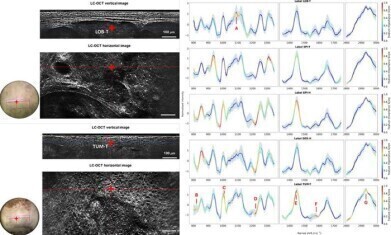
A compact dual-mode imaging system developed by French researchers has demonstrated high diagnostic accuracy in the noninvasive characterisation of nonmelanoma skin cancers. The approach integrates high-resolution structural and chemical information to support more precise classification of skin lesions and may offer clinicians a reliable alternative to biopsy-based methods.
The system combines two optical techniques: line-field confocal optical coherence tomography, which provides high-resolution cellular images, and confocal Raman microspectroscopy, which characterises the biochemical composition of tissue. Researchers at Saint-Étienne University Hospital and Paris-Saclay University, working in collaboration with Damae Medical, all located in France, have integrated these complementary modalities into a single instrument designed to operate in a clinical environment.
“By combining structural and chemical data, we aimed to deliver a more comprehensive and noninvasive diagnostic tool for skin cancer,” said the study’s lead Meriem Ayadh of Saint-Étienne University Hospital.
The team applied the system to more than 330 biopsy-confirmed samples of nonmelanoma skin cancer, including basal cell carcinoma and squamous cell carcinoma, and recorded more than 1,300 Raman spectra to train and validate an artificial intelligence model for tissue classification.
The model achieved 95 percent classification accuracy for basal cell carcinoma, and 92 percent when including squamous cell carcinoma, suggesting that the system can reliably discriminate cancerous lesions by their chemical profiles. The study also identified distinct biochemical signatures for different tumour types, offering potential insights into the biological mechanisms underpinning disease progression.
The developers have claimed that this dual-modality technique has the potential to reduce reliance on invasive sampling, accelerate clinical decision-making and improve patient outcomes. The system’s ability to deliver immediate, label-free chemical analysis alongside cellular imaging has been presented as a significant step forward in dermatological diagnostics.
This work represents a continuing trend towards the integration of advanced optical methods and artificial intelligence to support real-time, point-of-care diagnostic applications in oncology.
For further reading please visit: 10.1117/1.JBO.30.7.076008

Digital Edition
Lab Asia Dec 2025
December 2025
Chromatography Articles- Cutting-edge sample preparation tools help laboratories to stay ahead of the curveMass Spectrometry & Spectroscopy Articles- Unlocking the complexity of metabolomics: Pushi...
View all digital editions








Events
Jan 21 2026 Tokyo, Japan
Jan 28 2026 Tokyo, Japan
Jan 29 2026 New Delhi, India
Feb 07 2026 Boston, MA, USA
Asia Pharma Expo/Asia Lab Expo
Feb 12 2026 Dhaka, Bangladesh




