-
 The SPARDA research team. Credit: Vilnius University
 -
 Dr Mindaugas Zaremba. Credit: Vilnius University
 -
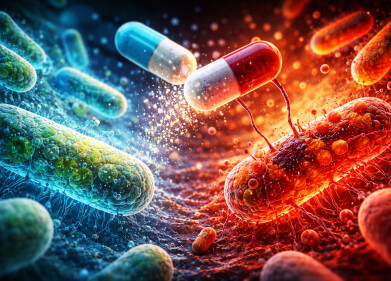
 Illustration: A single infected bacterium triggers a precise SPARDA response to halt viral spread in the population. Credit: Justinas Griciūnas
Research news
Bacterial argonautes reveal self-sacrificing viral defence strategy
Dec 16 2025
Vilnius University researchers have uncovered the molecular mechanics behind a powerful bacterial defence system, revealing how SPARDA (Short Prokaryotic Argonaute, DNase associated) proteins orchestrate the self-destruction of infected cells to block viral spread. Published in Cell Research, the study [1] combines cutting-edge microscopy and structural biology to shed light on a long-standing mystery in bacterial immunity.
Bacteria and viruses have been locked in a molecular arms race for billions of years. While systems like CRISPR-Cas are well understood, many other defence mechanisms, including SPARDA, remained largely unexplored - until now. SPARDA activates only when an invading virus is detected, sacrificing the infected bacterium to protect the wider population.
The breakthrough came through a combination of cryo-electron microscopy, X-ray crystallography, and single-molecule imaging, which allowed the team to capture SPARDA proteins at atomic resolution. They discovered that activation begins with an Argonaute protein, which recognises viral RNA fragments. A key structural element, the ‘beta-relay’, switches from an inactive ‘OFF’ state to an active ‘ON’ state, transmitting a signal that triggers filament formation. These spiraling protein filaments become the functional machinery that rapidly degrades viral and host DNA alike.
“This is a kind of cellular altruism – one bacterium dies to stop the infection and protect the rest of the community,” explained research supervisor and Research Professor at the Life Sciences Center of Vilnius University, Dr Mindaugas Zaremba. “SPARDA proteins coordinate this process in a highly precise way.”
Beyond fundamental biology, the findings have practical implications. In biotechnology, SPARDA could inspire highly precise nucleic acid detection tools. In medicine, the insights could inform phage therapy strategies, helping scientists anticipate bacterial resistance mechanisms.
The research was supported by the Research Council of Lithuania, Horizon Europe, CPVA, iNEXT, and the Vilnius University Research Promotion Fund.
More information online
- Activation of the SPARDA defense system by filament assembly using a beta-relay signaling mechanism widespread in prokaryotic Argonautes published in Cell Research



Digital Edition
Lab Asia Dec 2025
December 2025
Chromatography Articles- Cutting-edge sample preparation tools help laboratories to stay ahead of the curveMass Spectrometry & Spectroscopy Articles- Unlocking the complexity of metabolomics: Pushi...
View all digital editions









Events
Jan 21 2026 Tokyo, Japan
Jan 28 2026 Tokyo, Japan
Jan 29 2026 New Delhi, India
Feb 07 2026 Boston, MA, USA
Asia Pharma Expo/Asia Lab Expo
Feb 12 2026 Dhaka, Bangladesh




