-
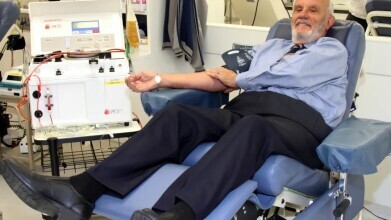 Australian James Harrison donated blood 1,173 times every two weeks between the ages of 18 and 81. Credit: AP pool image via Australian Red Cross
Blood
Australian man whose donations of rare blood saved the lives of millions of babies, dies at 88
Mar 28 2025
James Harrison gave his blood plasma more than 1,100 times to produce ‘anti-D’ medication for
James Harrison, known in Australia as ‘the man with the golden arm’ because of his prolific life-saving blood donations, has died aged 88.
In his lifetime, Harrison rolled up his sleeve more than 1,100 times to donate his blood plasma which was used for 2.4m injections of ‘anti-D’ which saved at-risk babies.
Anti-D injections are given to Rhesus D-negative mothers whose blood is at risk of attacking their unborn babies if they are Rhesus D-positive. Without it, babies can suffer from haemolytic disease of the foetus and newborn (HDFN), which is often fatal.
Harrison’s blood was special and important because it contained a ‘rare’ antibody, which was then essential to make the anti-D injections. A dose of the Routine Antenatal Anti-D Prophylaxis (RAADP) is now administered at around week 28 of the pregnancy for all pregnant RhD negative women in second and subsequent pregnancies.
Harrison first donated blood in 1954 and reportedly never missed a fortnightly appointment. His final donation was in 2018, aged 81. He was inspired after undergoing lung surgery as a 14-year-old, himself receiving many blood transfusions, a spokesperson for the Australian Red Cross said.
Since the introduction of the anti-D treatment in the 1960s, mothers and babies no longer face the adverse outcomes of HDFN. The disease occurs when blood types of a mother and baby are incompatible and can result in miscarriage, stillbirth and other complications.
Dr David De Leacy, a retired Australian pathologist and transfusion specialist, said the disease was now ‘an historical problem’ thanks to anti-D. De Leacy said that anti-D treatment was like immunisation against any other virus, with babies protected if it was administered early enough.
Harrison was awarded the Medal of the Order of Australia for: “service to the community, particularly through the plasmapheresis blood donor scheme” in the Queen’s Birthday Honours List on June 14, 1999.
“He was … very proud to have saved so many lives, without any cost or pain,” said Tracey Mellowship, Harrison’s daughter.
“It made him happy to hear about the many families like ours, who existed because of his kindness.”
The Australian Red Cross said recruiting new anti-D donors was as an ongoing challenge with fewer than 200 anti-D donors nationwide, who help about 45,000 mothers and babies annually.
The CEO of Australian Red Cross Lifeblood, Stephen Cornelissen, described Harrison as a ‘remarkable, stoically kind’ man who ‘extended his arm to help others and babies he would never know’.
In addition to the two million doses from his donations, laboratories still hold blood donated by Harrison. With his blood and that from other donors, scientists are attempting to grow the anti-D antibody in the lab.
Digital Edition
Lab Asia Dec 2025
December 2025
Chromatography Articles- Cutting-edge sample preparation tools help laboratories to stay ahead of the curveMass Spectrometry & Spectroscopy Articles- Unlocking the complexity of metabolomics: Pushi...
View all digital editions









Events
Jan 21 2026 Tokyo, Japan
Jan 28 2026 Tokyo, Japan
Jan 29 2026 New Delhi, India
Feb 07 2026 Boston, MA, USA
Asia Pharma Expo/Asia Lab Expo
Feb 12 2026 Dhaka, Bangladesh




