-
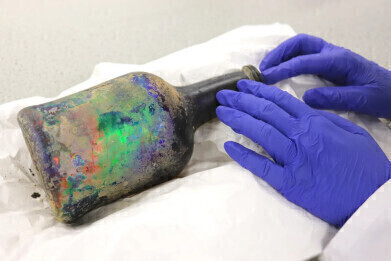 'Witch Bottle' investigated at the University of Lincoln. Credit: Josephine McKenzie
 -
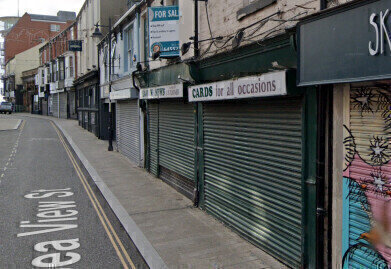 Site of bottle find at 35-37 Seaview Street, Cleethorpes. Source: Google Maps Streetview
X-Ray
Mystery of 200-year-old bottle revealed by X-ray fluorescence
Feb 11 2025
Analysis by University of Lincoln student showed that the building-site-find did not contain rum
The liquid contents of a 200-year-old bottle, discovered during construction work in Cleethorpes, England, has been shown not to be rum – as was first assumed by the builders who found it.
Discovered embedded in a wall, which was revealed below ground level as builders were digging a trench, the bottle was intact, stoppered with original cork and still filled with a liquid contents.
Retrieving the bottle, the site manager delivered it to the University of Lincoln’s Conservation of Cultural Heritage department for further analysis. The renovation site formed part of a wider heritage preservation project in this older part of the east England town.
The bottle was investigated by undergraduate mature student, Zara Yeates, who used X-ray fluorescence (XRF) analysis to reveal what made up the contents without removing cork from the bottle.
XRF is a non-destructive technique that determines the elemental composition of materials by measuring the fluorescent (or secondary) X-rays emitted from a sample when it is excited by a primary X-ray source. Each element that is present in a sample will produce a set of characteristic fluorescent X-rays ─ as unique as a fingerprint ─ for each specific element contained in the sample.
Other tests were used to determine if the bottle had any other contents other than liquid. These scans showed that the bottle contained only liquid.
Yeates identified that the bottle was likely to have been made between 1790 and 1840. The general shape of this particular bottle had been introduced in 1790 but its overall uneven finish suggested it was hand-blown rather than pressed in a mould. After 1840 bottle moulds were widely used.
However, Yeates’ use of multispectral imaging revealed that the liquid inside the bottle was, rather deliciously, just urine.
Yeates told the BBC that the builders at the site had thought the old bottle was full of rum and had planned to take a drink from it.
“The fact that the bottle still had so much liquid in is really rare. From what we heard the builders would quite like to have taken a taste from the bottle. It’s a good thing the project manager stepped in to stop them given our findings.”
Yeates has proposed that it was a so-called ‘witch bottle’, an item which was quite commonly deployed around this part of England, in more superstitious times, as a protective item to ward away evil using apotropaic magic from a dwelling. The bottle will be on display at the University of Lincoln’s Conservation of Cultural Heritage final-year degree show in June 2025, before being returned to its owner.
For further reading please visit:
https://lincolnshiretoday.net/mag/zara-probes-mystery-in-a-bottle-of-cleethorpes-discovery/




Digital Edition
Lab Asia Dec 2025
December 2025
Chromatography Articles- Cutting-edge sample preparation tools help laboratories to stay ahead of the curveMass Spectrometry & Spectroscopy Articles- Unlocking the complexity of metabolomics: Pushi...
View all digital editions









Events
Jan 21 2026 Tokyo, Japan
Jan 28 2026 Tokyo, Japan
Jan 29 2026 New Delhi, India
Feb 07 2026 Boston, MA, USA
Asia Pharma Expo/Asia Lab Expo
Feb 12 2026 Dhaka, Bangladesh




