Research news
How a molecular ‘glue’ approach could tackle KRAS-driven drug resistance in some lung cancers
Jan 05 2026
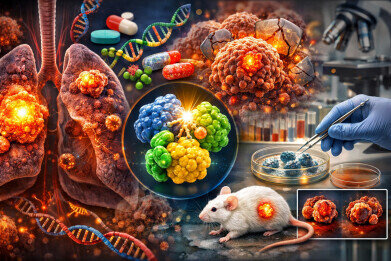
Researchers at the University of Michigan have identified a novel way to counter drug resistance in KRAS-mutant non-small cell lung cancer by stabilising a key tumour-suppressing protein complex, with promising results in cell and animal models
Lung cancer remains the second-most common cancer and the leading cause of cancer-related death worldwide. More than 80 per cent of cases are classified as non-small cell lung cancer, a broad group of tumours characterised by relatively larger cancer cells and slower growth compared with small cell lung cancer. Despite these differences, outcomes for patients remains poor, particularly when tumours harbour specific genetic alterations.
One of the most clinically significant drivers of non-small cell lung cancer is mutation of the KRAS gene, which encodes a protein central to cell growth and division. KRAS mutations occur in approximately 30 per cent of non-small cell lung cancer cases and are associated with shorter survival and a higher likelihood of resistance to treatment. Although several United States Food and Drug Administration (FDA) approved drugs now target KRAS-mutant tumours in lung, pancreatic and colorectal cancers, the benefit is often limited by the rapid emergence of resistance.
In its recent study a research team at the University of Michigan (UM), Ann Arbor, US has reported the identification of a novel protein target and the development of a drug strategy designed to address this problem in KRAS-mutant non-small cell lung cancer. The work focused on protein phosphatase 2A – abbreviated as PP2A – a tumour suppressor that has previously been shown to inhibit lung cancer development.
PP2A is not a single protein but a complex formed by three distinct protein subunits that must assemble correctly to function. Disruption of this assembly prevents PP2A from exerting its tumour-suppressive effects and has been observed across several cancer types, including lung, prostate and liver cancers. This observation led the research team to ask whether stabilisation of the PP2A complex could restore its function and suppress tumour growth in KRAS-driven disease.
“There are several FDA-approved drugs that target KRAS in pancreatic, colon and lung cancer,” said Dr. Goutham Narla, Louis Newburgh Research Professor of Internal Medicine at the UM and a member of the Rogel Cancer Center.
“Although they worked well initially, tumour cells gained resistance after a short period of time,” he added.
Using cell lines derived from KRAS-mutant non-small cell lung cancers, the researchers examined the effects of two widely used anti-cancer drugs, adagrasib and trametinib. They found that both agents destabilised the PP2A complex, an effect that may help to explain why resistance develops during treatment. When the team introduced a small molecule described as a molecular glue – known as RPT04402 – the situation changed markedly. The molecular glue promoted proper assembly of the PP2A complex, restored its activity and led to cancer cell death.
The researchers went on to confirm these findings in mouse models of KRAS-mutant non-small cell lung cancer. In these experiments, treatment with the molecular glue caused tumours to shrink, and the combination of either adagrasib or trametinib with RPT04402 significantly delayed the onset of resistance. In mice, the combined treatment extended therapeutic effectiveness to more than 150 days, a substantial improvement compared with either agent alone.
“Although we tested several cell lines and animal models, we do not know whether this combination will work in every case of non-small cell lung cancer,” Narla said.
“Our findings represent around 20 to 30 per cent of cases,” he added, a figure that reflects the proportion of lung cancers driven by KRAS mutations.
The team has indicated that it plans to initiate clinical trials in the near future, working in collaboration with SpringWorks Therapeutics and Merck. In parallel, the researchers aim to extend their investigation to other KRAS-mutant tumours to assess whether the same strategy could enhance treatment responses in pancreatic and colorectal cancers.
If successful, the approach could offer a broadly applicable means to counter one of the most persistent challenges in targeted cancer therapy, namely the evolution of drug resistance.
For further reading please visit: 10.1172/JCI193790



Digital Edition
Lab Asia Dec 2025
December 2025
Chromatography Articles- Cutting-edge sample preparation tools help laboratories to stay ahead of the curveMass Spectrometry & Spectroscopy Articles- Unlocking the complexity of metabolomics: Pushi...
View all digital editions









Events
Jan 21 2026 Tokyo, Japan
Jan 28 2026 Tokyo, Japan
Jan 29 2026 New Delhi, India
Feb 07 2026 Boston, MA, USA
Asia Pharma Expo/Asia Lab Expo
Feb 12 2026 Dhaka, Bangladesh




