News
What Do the Latest Results from the Large Hadron Collider Mean?
Sep 01 2015
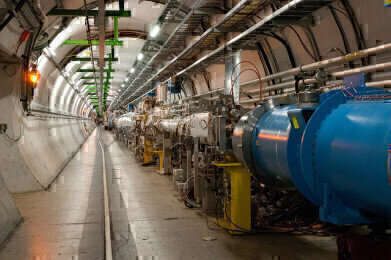
Early this June the European Organization for Nuclear Research (CERN) began receiving results from its next generation Large Hadron Collider (LHC). The $10 billion machine is the world's largest and most powerful particle accelerator and was engineered to help physicists delve into the mysteries of the universe.
Now, the LHC has started to deliver particle collisions energy levels that are 63% higher than previously attained. The results were presented at the European Physical Society High Energy Physics conference held in Vienna, and offered attendees fascinating insight into the new data that’s been extracted since the LHC restarted after two years in cessation.
So what was revealed? Read on for an overview of some of the highlights.
Higher collision levels
While previous collision energy levels were recorded at 8 TeV, the LHC has now reached dizzying new heights of 13 TeV¹. This is on the brink of the speed of light and increases the rapidity of protons from 299 792 449 metres per second to 299 792 454 m/s. While the increase is technically just 5 m/s the higher energies offer scientists a glimpse into the hearts of atoms. This will allow them to study matter structure at miniscule distance scales. In this sense, the LHC is more or less an enormous microscope.
Calculating minimum bias
When proteins collide at higher energy levels scientists are able to count the particles that are produced. These are referred to as “minimum bias” measurements and serve as a benchmark for all subsequent measurements.
Short distance physics
The LHC has been able to record the production of hadron jets when quarks and gluons collide at short distances. The measurement of these jets offers scientists the first real insight into short distance physics!
LHC full of surprises
One of the most exciting developments unearthed by the LHC is the fact that it challenges existing perceptions on particle collision explanations. The new measurements indicate that quarks and gluons demonstrate collective flow during collisions which is a big surprise for scientists who were previously satisfied with prevailing theories.
There are some incredibly exciting new developments on the horizon, and cutting edge particle analysis technology lies at the heart of the revolution. In the article ‘Particle Characterisation with Dynamic Image Analysis Determination of particle size and particle shape with a new measuring technique’ researchers examine long established particle size distribution determination methods, including sieve analysis, laser diffraction and a revolutionary new technique called Dynamic Image Analysis (DIA).
Images sourced via Flickr Creative Commons. Credits: HoangP




Digital Edition
Lab Asia Dec 2025
December 2025
Chromatography Articles- Cutting-edge sample preparation tools help laboratories to stay ahead of the curveMass Spectrometry & Spectroscopy Articles- Unlocking the complexity of metabolomics: Pushi...
View all digital editions








Events
Jan 21 2026 Tokyo, Japan
Jan 28 2026 Tokyo, Japan
Jan 29 2026 New Delhi, India
Feb 07 2026 Boston, MA, USA
Asia Pharma Expo/Asia Lab Expo
Feb 12 2026 Dhaka, Bangladesh




