Laboratory news
Chemistry labs that exclude disabled scientists risk skills gap warns RSC
Dec 11 2025
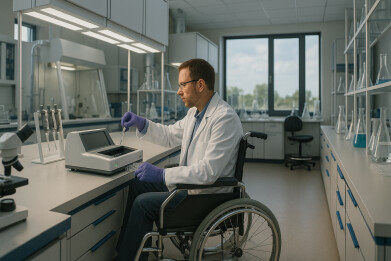
An RSC report has found that inaccessible laboratories and inflexible workplace cultures push disabled chemists out of experimental roles and threaten the sector’s ability to meet growing demand for expertise in the UK and worldwide
Inaccessible chemistry laboratories mean that chemistry research is losing skilled people and risk an acute shortage of expertise as demand for chemists grows in the UK and around the world. That conclusion has emerged from a report from the RSC (RSC), which has examined how disability, physical access, equipment design and workplace culture intersect in the design of modern laboratories.
The report – published by the RSC – has set out evidence of significant and systemic barriers that disabled chemists face and has urged the sector to rethink how it designs laboratories, writes policy and shapes its professional culture. The society has argued that inclusion in chemistry cannot rely on individual goodwill or informal workarounds but must instead become an explicit requirement for laboratory infrastructure and organisational practice.
“We are not calling for laboratories to be torn down and rebuilt at great expense. We are asking the chemical sciences to apply the same creativity, problem-solving and collaborative spirit that defines chemistry itself to the spaces in which we work,” said Dr. Helen Pain, chief executive of the RSC.
She described accessibility as an issue of both equity and competitiveness, because exclusion of talent with disabilities limits the sector’s capacity to respond to industrial, environmental and healthcare challenges that depend on innovation in chemical research.
More than 400 people took part in the society’s research, which combined survey data with qualitative accounts from respondents in academia, industry and government labs. Participants acknowledged that there has been progress made on disability inclusion in recent years, for example through equality legislation, formal reasonable-adjustment policies and a greater willingness on the part of employers to discuss access needs.
However, there were reports that stigma, inconsistent support and discrimination have remained common and have too often translated into a diminished sense of belonging, reduced job security and constrained career options for disabled chemists.
The data showed that while most survey respondents, disabled and non-disabled, work in wet laboratories, disabled respondents are proportionately more likely to work in computational laboratories or office-based roles. The report has warned that this pattern may not reflect true career preference. Instead it has likely arisen because laboratory design, safety procedures and organisational expectations exclude many disabled scientists from experimental spaces, so they move towards roles where they can work more independently or with fewer barriers.
When the RSC asked about obstacles in the laboratory, disabled respondents most frequently cited a lack of awareness of support needs among colleagues and managers, time constraints that leave no space to plan or implement adjustments, and sensory overload from noise, alarms, odours and crowded environments. These factors often mean delayed completion of experiments, longer working hours and a greater reliance on assistance from colleagues. Many disabled chemists reported that they have had to alter their career paths in order to avoid inaccessible laboratory environments, rather than to follow their scientific interests.
This picture has been reflected in career outcomes with interviewees reporting that disabled individuals are less likely to hold senior roles in the chemical sciences and face more and greater obstacles to progression. Promotion criteria that emphasise uninterrupted laboratory productivity, conference attendance and constant visibility in departmental life can disadvantage those who may require flexibility with schedules, remote work, tailored equipment or medical leave. Career progression has suffered in ways that are both structural and personal.
“[So-called] ‘normal’ chemists will teach, attend meetings, go to conferences to network, socialise, interact with other staff, students and technicians which I cannot do,” said a disabled academic chemist ‘A’ quoted in the report.
“[This] means I am stuck on grade 8 while everyone else gets promoted. I simply do not have anyone to be compared with and argue my case for promotion,” they added.
Many universities in the UK grade academic posts from 1–10, with grade 10 usually associated with a senior professor who heads a large department or faculty. The report has used examples such as ‘A’ to illustrate how standard promotion frameworks can ignore the additional labour that disabled staff undertake to navigate inaccessible systems.
The RSC has stressed that accessible design is not limited to wheelchair ramps or wider corridors. It covers the height and adjustability of benches and fume cupboards, the placement and weight of doors, the clarity of signage, the acoustic environment, the usability of personal protective equipment for people with sensory or motor impairments, and the flexibility of digital systems that control instrumentation. It also encompasses safety procedures that assume every scientist can hear alarms, read visual displays and evacuate at a similar rate.
In its call for accessible laboratory design, the report made a range of recommendations that span practice, training and policy. These included clear guidance for disabled laboratory users on how to request and secure adjustments, so that individuals do not have to improvise solutions or rely on informal favours. The authors urged organisations to ensure that non-disabled laboratory users take part in disability awareness training that covers both visible and non-visible impairments, so that colleagues understand how design choices and everyday habits can create barriers. The report has also encouraged departments and companies to share experience across groups and institutions, rather than to treat each adaptation as an isolated case.
At policy level, the RSC has called on funders, regulators and professional bodies to establish minimum accessibility standards for laboratories and to support upgrades where facilities fall short. The report argued that procurement decisions, building regulations and funding criteria should all embed accessibility as a core requirement, rather than treat it as an optional enhancement. Without such measures, the authors warned that laboratories will continue to evolve around a narrow idea of the ‘standard’ chemist and will therefore exclude many potential contributors.
The RSC has framed accessibility as a driver of better science. More inclusive laboratories can support a wider range of sensory perspectives, problem-solving approaches and lived experience, which in turn can expand the questions that chemists ask and the solutions that they devise.
To read the RSC's report please click here


Digital Edition
Lab Asia Dec 2025
December 2025
Chromatography Articles- Cutting-edge sample preparation tools help laboratories to stay ahead of the curveMass Spectrometry & Spectroscopy Articles- Unlocking the complexity of metabolomics: Pushi...
View all digital editions










Events
Jan 21 2026 Tokyo, Japan
Jan 28 2026 Tokyo, Japan
Jan 29 2026 New Delhi, India
Feb 07 2026 Boston, MA, USA
Asia Pharma Expo/Asia Lab Expo
Feb 12 2026 Dhaka, Bangladesh




