Laboratory events news
ELRIG 2025: AI-led cell metrology aims to standardise quality for cell diagnostics
Dec 23 2025
Artificial intelligence-supported cell imaging could help laboratories to set defensible quality thresholds for living products, according to Dr Jeanne Rivera of the National Measurement Laboratories. She argues that regulators and manufacturers now need measurement approaches that captures what state those cells occupy not merely how many cells exist in a sample
Dr Jeanne Rivera, Cell Metrology Team Leader and Flow Specialist at the National Measurement Laboratories (NML), in Leeds, UK, suggest there should be a shift in how life science teams measure cells, emphasising artificial intelligence (AI) and image-derived profiling. Rivera said that the UK’s existing infrastructure can be tasked to help teams to make cell-based products and assays more reliable, comparable and usable.
Rivera said that modern cell measurement has often prioritised simple quantitative read-outs such as counts, viability and marker expression. These remain essential but cannot fully capture the behaviour of living systems that can drift or degrade. Rivera argued that laboratories now need richer, image-based descriptions of cell state, and that AI offers a realistic route to standardise analysis at scale.
The NML a constituent past of the UK National Measurement System, is described by Rivera as the UK’s designated institute for chemical and biological measurement. NML operates within the framework of the Laboratory of the Government Chemists (LGC) and works alongside the Medicines and Healthcare products Regulatory Agency (MHRA) as well as other reference bodies.
She detailed that NML’s role extends beyond tools which can produce measurements to ensuring that data remains meaningful as technologies evolve. The institute also contributes to international standards work through the International Organization for Standardization and engages with emerging methodologies.
This early engagement drives NML’s strategic partnerships with universities, including the University of Leeds. Rivera framed such links as a deliberate effort to connect early-stage innovation with later-stage regulatory and manufacturing realities. As novel analytical platforms enter the market, she said, key questions arise:
- What does an instrument truly measure?
- How reproducible are the results?
- What thresholds define acceptable variation when products enter development pipelines?
Within her team’s work, Rivera highlighted the concept of critical quality attributes – characteristics such as viability, identity, potency and purity that define product quality. She argued that morphology should increasingly join this list, because cell shape and structure often reflect health, stress, differentiation and function. Traditional approaches have focused on quantification but Rivera suggests that modern metrology requires integration of both cell numbers and their condition.
Morphological cell profiling, she explained, offers an unbiased imaging-based approach that measures multiple properties of cells simultaneously and applies statistical learning to detect signatures linked to culture conditions or disease. The goal is to treat morphology as a proxy for biological state and to detect shifts that influence manufacturing consistency, yield and safety.
Rivera used conventional flow cytometry to illustrate current limitations. Simple gating on plots such as area versus height can appear to identify single cells yet still include aggregates or doublets. These errors, she said, are not technical nuisances but measurement problems that can distort analysis, affect assessments of cell quality and influence product-release decisions.
She presented two case studies to illustrate how AI-supported morphology could improve both manufacturing and clinical measurement.
The first concerned cell line ageing which Rivera described as a persistent challenge in cell production. She argued that cellular heterogeneity and progressive change during passage can undermine product consistency, particularly for cell-based therapies and biologics. She noted that standards bodies are now revising guidance on tumourigenicity, viability and analytical methods to reflect these realities, while also recognising regulatory and ethical guardrails.
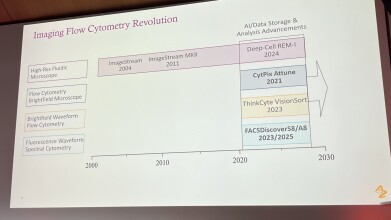
To demonstrate why morphology matters, Rivera described work with MRC-5 human fibroblast cells. Imaging in her laboratory showed that morphology varied with health state, with parameters such as area and eccentricity indicating culture quality. She linked this to high-throughput imaging flow and ‘ghost cytometry’, which combine optical data with machine learning to infer cell properties without labelling. Distinct morphological profiles, she said, can separate healthy from unhealthy populations and support reproducible quality control.
In experiments comparing early-passage cells, late-passage cells and cells exposed to ultraviolet stress, late-passage cells showed clustering patterns distinct from the stressed population. Rivera interpreted this as evidence that ageing-related change is not equivalent to generic stress. Using an AI-enabled, label-free platform, her team identified clusters corresponding to different cell states. Metrics such as roundness, area and perimeter differed significantly between groups. She highlighted perimeter as a particularly discriminating feature, consistent with functional changes linked to altered morphology.
A distinctive aspect of this work, Rivera said, was use of a ‘human foundation model’ for cell images. Such models, trained on diverse datasets, can extract large numbers of features beyond conventional morphology pipelines. Instead of a few descriptors, the workflow could identify hundreds of textural and structural features that differ between conditions. Rivera noted that some of these could serve as measurable thresholds for quality standards. Automation, she added, is essential to analyse thousands of images objectively and with reproducibility. She now plans to extend her work to induced pluripotent stem cells.
Her second case study focused on paroxysmal nocturnal haemoglobinuria (PNH), an acquired blood-borne condition caused by somatic mutation in blood stem cells that leads to haemolysis. Flow cytometry remains central to diagnosis, through detection of the CD59 protein, but Rivera explored how morphology could add some diagnostic value.
She explained that red blood cells (RBCs) change in shape as they age, and that prior microscopy studies have shown PNH samples contain fewer normal discocytes and more spiky, misshapen forms. Rivera’s team used brightfield imaging with fluorescence-informed gating to define populations, then applied dimensional reduction to identify clusters. Some clusters represented normal RBCs, while others contained distinctive spiky morphologies. Patient samples produced clearly different cluster distributions, which aligned with clinical annotations distinguishing healthy controls, severe PNH and breakthrough haemolysis.
Further analysis revealed morphological differences between CD59-high, CD59-low and CD59-negative populations. Collaborators interpreted the CD59-low group as an intermediate disease subtype. Rivera emphasised that morphology-based clustering, once validated, could improve diagnostic precision and allow laboratories to detect subtle clinical shifts.
She then described a larger, label-free analysis involving tens of thousands of RBC images. After removal of artefacts, clustering again reflected patient-specific morphology patterns that correlated with disease severity and treatment. AI-based feature extraction identified textural descriptors matching the spiky appearance of affected RBCs which conventional morphology measures capture only imperfectly.
Rivera concluded her presentation by looping back to discuss NML’s mission. Across biomanufacturing and clinical contexts, she stated that AI-supported, label-free morphological profiling can deliver more informative quality assurance and more reproducible cell measurement. The opportunities, she said, lie in the ability to quantify shape, texture and structure routinely during culture and sample processing, and to convert those measurements into thresholds and standards the wider community can adopt.
Such approaches, Rivera said, would allow measurement science to keep pace with the growing reality of cell-based products.


Digital Edition
Lab Asia Dec 2025
December 2025
Chromatography Articles- Cutting-edge sample preparation tools help laboratories to stay ahead of the curveMass Spectrometry & Spectroscopy Articles- Unlocking the complexity of metabolomics: Pushi...
View all digital editions








Events
Jan 21 2026 Tokyo, Japan
Jan 28 2026 Tokyo, Japan
Jan 29 2026 New Delhi, India
Feb 07 2026 Boston, MA, USA
Asia Pharma Expo/Asia Lab Expo
Feb 12 2026 Dhaka, Bangladesh




