News
How to Measure Ripples in Space Time
Dec 19 2015
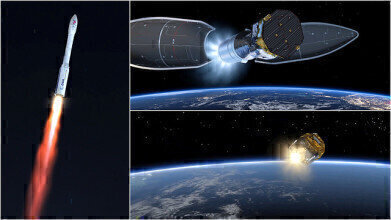
Space scientists are continually striving to achieve new feats, and The European Space Agency (ESA) is the latest entity to make history. Earlier this month, the ESA launched a rocket loaded with two cubes made of platinum and gold. At a cost of over US$450 million, the LISA Pathfinder goal is to find out how the cubes react to being in freefall almost a million miles from Earth.
Foundations for the future
While it sounds like a somewhat irrational enterprise, the project is actually paving the way for a second, more ambitious mission. During this project, space scientists will attempt to shield the cubes from external influences. By creating a practically perfect cosmic isolation chamber, the scientists will be able to accurately measure the infinitesimal effects of gravitational waves.
According to Oliver Jennrich, one of the projects space scientists, "Our biggest enemy is the light from the sun that hits the satellite and pushes it around."
To counter the influential rays, the satellite will be equipped with thrusters that are able to make miniscule correction to the probe’s position. This will ensure that it remains in the correct orbit pattern, and doesn’t cause the cubes to move around inside the box.
When the results are in, the ESA plans to kick-start a project that will see scientists attempt to measure ripples in space time. These are caused by massive objects that lurk throughout the galaxy, including black holes.
"We want to see whether we can create an environment in orbit that's free of interference, and where we can conduct these high-precision measurements," explains Michael Menking. As senior vice-president for Earth observation, navigation and science at Airbus Defence and Space, Menking knows his stuff.
Building on Einstein’s groundwork
It’s a next generation project, however it’s not necessarily an entirely new concept. One century ago, Albert Einstein predicted the existence of gravitational waves, but was never able to prove his theory. If all goes to plan, the second stage of the project will be ready to launch in 2034.
"It's probably the most challenging mission we're doing in the science program, because the precision by which you need to measure the test mass position is very, very high," said Arvind Parmar, head of the European Space Agency's scientific support office.
Gravity is an unstoppable force, however in the 1920s scientists discovered that ultracentrifuges have the ability to generate forces that are millions of times stronger than the natural phenomenon. ‘Technical Considerations for Ultracentrifugation’ looks at how the development devices has permitted the fractionation of subcellular components which were previously visible only through the use of an electron microscope. Now, scientists can use modern ultracentrifugation to determine the shape, size and weight of macromolecular complexes.
Image via Flickr Creative Commons. Credits: European Space Agency ?

Digital Edition
Lab Asia Dec 2025
December 2025
Chromatography Articles- Cutting-edge sample preparation tools help laboratories to stay ahead of the curveMass Spectrometry & Spectroscopy Articles- Unlocking the complexity of metabolomics: Pushi...
View all digital editions







Events
Jan 21 2026 Tokyo, Japan
Jan 28 2026 Tokyo, Japan
Jan 29 2026 New Delhi, India
Feb 07 2026 Boston, MA, USA
Asia Pharma Expo/Asia Lab Expo
Feb 12 2026 Dhaka, Bangladesh




