News
Could Lasers Hide the World from Aliens?
May 07 2016
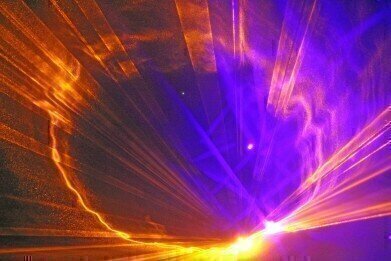
For some, aliens are a complete paradox. For others, the existence of extra-terrestrial life is absolute. Realistically, there’s no solid proof to back up either argument. Either way, space scientists are asserting that lasers could be the key to protecting Earth from alien invasion, or actively broadcasting its presence. Needless to say, they’re two very different concepts.
So how could shining a laser into outer space defend or victimise earthlings? According to a pair of astronomers, a high powered laser beam could cancel out the shadow effect the Earth has on the sun’s rays. Over the years thousands of orbiting planets have been discovered simply from noting how they block out their stars at regular intervals. NASA’s prolific Kepler space telescope employs this technique, and has already honed in on planets that could support extra-terrestrial life.
Friend or foe?
There’s fierce debate over whether or not alien inhabitants would be hostile, with high profile names such as Stephen Hawking and SpaceX founder Elon Musk warning that they could be unreceptive. David Kipping of New York’s Columbia University agrees, and has developed a cloaking system designed to shield Earth from unwanted eyes.
“If you were feeling xenophobic and you were worried about encounters with other civilisations, based on, for example, human history of different civilisations clashing, you might choose to conceal your planet,” he explains.
Could lasers hide Earth from unwanted eyes?
Together with student Alex Teachey, the pair hypothesise that firing a constant 30 megawatt laser towards the face of the sun for 10 hours per year would neutralise the shadow Earth makes in its rays. This is based on the theory that from the outlook of a given star, Earth intercepts with the sun’s face for just 10 hours every 365 days.
While Kipping and Teachey are confident that a high powered laser would shield Earth from unwanted cosmic neighbours, others are concerned that the beam could act as a beacon. Kipping also admits the plan has its flaws, as the lasers could actively warp the Earth’s starlight patterns and alert aliens to its presence.
As well as stimulating conversations with alien life, light is also a pivotal scientific medium here on planet Earth. ‘Light Source Characterisation in Life Sciences’ introduces readers to the importance of photonics, and its role across a host of arenas, including life science, biological research, biomedical instrumentation and agriculture.



Digital Edition
Lab Asia Dec 2025
December 2025
Chromatography Articles- Cutting-edge sample preparation tools help laboratories to stay ahead of the curveMass Spectrometry & Spectroscopy Articles- Unlocking the complexity of metabolomics: Pushi...
View all digital editions








Events
Jan 21 2026 Tokyo, Japan
Jan 28 2026 Tokyo, Japan
Jan 29 2026 New Delhi, India
Feb 07 2026 Boston, MA, USA
Asia Pharma Expo/Asia Lab Expo
Feb 12 2026 Dhaka, Bangladesh




