-
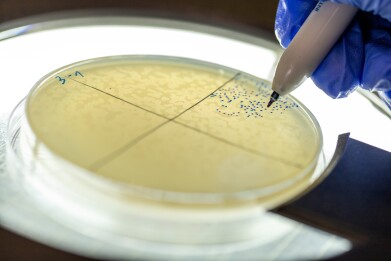 Plaques formed by phage lambda on an E. coli culture are being counted by Adi Levkowitz. Credit: Yosef Adest
 -
 Dr. Sahar Melamed. Credit: Bruno Charbit
Research news
Hidden viral RNA switch reshapes understanding of bacteriophage infection mechanism
Dec 19 2025
Researchers at the Hebrew University of Jerusalem have identified a conserved small RNA molecule that enables bacteriophages to reprogramme bacterial cells following infection, a finding that reshapes fundamental views of viral control and may inform future phage-based therapies for antibiotic-resistant infections
A study from the Hebrew University of Jerusalem, Israel, has revealed a previously unrecognised mechanism by which bacteriophages – the viruses that infect bacteria – take control of their host cells. The research has shown that a tiny viral RNA molecule acts as a molecular switch that alters bacterial gene expression and accelerates viral replication.
Bacteriophages – shortened to phages – infect bacteria and redirect cellular machinery to produce more viral particles. Although phage biology has been studied for decades, most research has focused on viral proteins as the primary drivers of this process. The latest findings have demonstrated that phages also deploy small RNA molecules to exert precise and rapid control over infected cells.
At the centre of the study is a small RNA molecule known as PreS. The researchers have shown that PreS enables the phage to intervene after bacterial genes have already been transcribed into messenger RNA (mRNA). This timing is significant because it allows the virus to reprogramme the host cell at a late stage, adding an additional and previously underappreciated layer of regulation during infection.
The work has been led by Dr Sahar Melamed, alongside research colleague Dr. Aviezer Silverman, and MSc student Raneem Nashef and computational biologist Reut Wasserman, in collaboration with Professor Ido Golding from the University of Illinois Urbana-Champaign, United States. Together, the team discovered that PreS binds directly to specific bacterial mRNAs and modifies their structure in a manner that benefits the virus.
Antibiotic resistance represents one of the most serious global health threats with current estimates suggesting that infections caused by antibiotic-resistant bacteria could kill up to 10 million people each year worldwide by 2050. Against this backdrop, phage therapy, which relies on viruses that selectively infect bacteria, has attracted renewed interest as a potential alternative or complement to antibiotics.
By clarifying how phages manipulate bacterial cells at the molecular level, the study has provided fundamental insights that could support the development of more effective phage-based treatments. Rather than relying solely on trial-and-error approaches, researchers may be able to design phages with predictable behaviours and therefore enhance their therapeutic performance.
Using an advanced technique to map RNA–RNA interactions – known as RIL-seq – the researchers identified one of PreS’ principal targets as the bacterial mRNA that encodes DnaN – a protein that plays a central role in DNA replication. And by increasing the production of DnaN, the phage gains an advantage early in infection, enabling faster copying of its own genetic material.
PreS exerts its effect by altering the shape of the dnaN mRNA. Under normal conditions, part of this RNA folds into a compact structure that limits access by ribosomes, the molecular machines responsible for protein synthesis. When PreS binds to this region, it opens the folded structure and permits ribosomes to translate the message more efficiently. The result is an increase in DnaN protein levels, accelerated viral DNA replication and a more robust infection.
When the researchers removed PreS or disrupted its binding site, the phage became less effective. Viral replication slowed, the destructive phase of infection was delayed and fewer viral particles were produced. These observations confirmed that PreS plays a decisive role in infection success rather than acting as a minor regulatory feature.
“This small RNA gives the phage another layer of control,” said Dr Sahar Melamed.
“By regulating essential bacterial genes at exactly the right moment, the virus improves its chances of successful replication. What astonished us most is that phage lambda, one of the most intensively studied viruses for more than 75 years, still hides secrets.
“Discovering an unexpected RNA regulator in such a classic system suggests we have only grasped a single thread of what may be an entirely richer, more intricate tapestry of RNA-mediated control in phages,” he added.
The discovery is notable because small RNAs have not traditionally been viewed as major contributors to phage biology. However, PreS is highly conserved among related viruses which suggests that many phages may share a common toolkit of RNA regulators that have remained unexamined.
Understanding how phages control bacterial cells is essential both for basic molecular biology and for applied medical research. As interest in phage therapy continues to grow, detailed mechanistic knowledge will be critical to ensure safety, reliability and effectiveness.
For further reading please visit: 10.1016/j.molcel.2025.11.019

Digital Edition
Lab Asia Dec 2025
December 2025
Chromatography Articles- Cutting-edge sample preparation tools help laboratories to stay ahead of the curveMass Spectrometry & Spectroscopy Articles- Unlocking the complexity of metabolomics: Pushi...
View all digital editions










Events
Jan 21 2026 Tokyo, Japan
Jan 28 2026 Tokyo, Japan
Jan 29 2026 New Delhi, India
Feb 07 2026 Boston, MA, USA
Asia Pharma Expo/Asia Lab Expo
Feb 12 2026 Dhaka, Bangladesh




