-
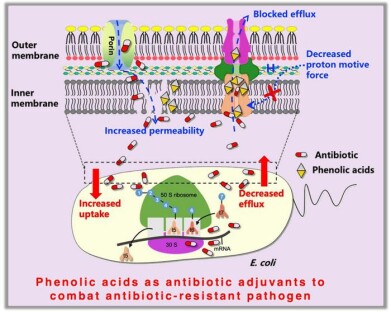 Plant phenolic acids enhance antibiotic efficacy against multidrug-resistant extraintestinal pathogenic E. Coli. Credit: Anping Peng, Lichun Yin, Xingshuo Wang, Shengyu Yuan, Meilun Wang & Zeyou Chen
Research news
Plant phenolic acids restore tetracycline power against drug resistant E. coli
Dec 10 2025
Researchers in China have shown that plant derived phenolic acids can act as potent adjuvants for tetracycline, revitalising the ageing antibiotic against multidrug resistant Escherichia coli, boosting bacterial killing in insect infection models and suppressing the evolution of further resistance
Plant derived phenolic acids have dramatically enhanced the activity of existing antibiotics against multidrug resistant Escherichia coli (E. coli) in laboratory studies, in work that offers a potentially powerful novel tool in the global response to antimicrobial resistance (AMR). In a series of both in vitro and in vivo experiments, these naturally occurring compounds not only enabled an older antibiotic to kill resistant bacteria more efficiently but also reduced the likelihood that further resistance would emerge.
AMR has become a major threat to human and animal health worldwide as common infections increasingly fail to respond to existing treatments. At the same time, the discovery and development pipeline for novel antibiotics has dramatically slowed, with very few agents having reached patients in recent decades.
Tetracycline, one of the earliest broad-spectrum antibiotics, has remained in extensive use, particularly in livestock production, because it is relatively inexpensive and easy to administer. However, resistance levels in pathogens such as E. Coli have risen across many regions, including East Asia, the Pacific and sub-Saharan Africa.
“Instead of waiting many years and spending enormous resources to develop brand novel antibiotics, we [have] showed that small molecules already present in plants can breathe new life into the drugs we rely on today,” said senior author Dr. Zeyou Chen of Nankai University in Tianjin, China.
“Our findings suggested that something as simple as pairing the right plant compound with an existing drug could make a real difference for difficult infections,” he said.
Because the route from discovery to regulatory approval for a completely novel medicine can take more than 10 years and cost more than US$1bn, many researchers have turned to antibiotic adjuvants. These are molecules that restore or enhance the activity of established drugs, for example by improving uptake into bacterial cells or by disabling bacterial defence mechanisms.
Phenolic acids belong to a large family of small aromatic compounds that plants use as part of their own defence against microbes and insects. They have already been associated with antioxidant and antimicrobial properties in a range of food and forage species, which has made them attractive candidates for repurposing as antibiotic adjuvants.
In this study, the research team evaluated 15 different phenolic acids, including salicylic (aspirin), gallic, caffeic and gentisic acids. They assessed each compound in combination with tetracycline against multidrug resistant E. Coli strains that had been isolated in the laboratory and from extraintestinal pathogenic infections. Using standard microdilution assays to determine minimum inhibitory concentrations, together with checkerboard assays to quantify interactions, the investigators found that all 15 phenolic acids acted synergistically with tetracycline. In practical terms, the combinations allowed the use of substantially lower tetracycline doses to halt bacterial growth than tetracycline alone.
‘Time kill’ experiments provided further insight into the impact on bacterial viability. Tetracycline or phenolic acids alone had only modest effects on the resistant strains at the tested concentrations. By contrast, the combinations led to sustained and often rapid bacterial killing, in some cases with visible cell lysis under the microscope. The researchers also noted that several phenolic acids enhanced the activity of kanamycin – an aminoglycoside antibiotic – which suggested that the underlying mechanism might apply to more than one antibiotic class.
Mechanistic investigations indicated that the phenolic acids acted at multiple points in the bacterial cell. One key effect involved intracellular accumulation of tetracycline. The team employed a fluorescent whole cell biosensor strain that glowed in proportion to tetracycline uptake and showed that all of the phenolic acids increased intracellular tetracycline in a clear dose dependent manner while, at the same time, they suppressed bacterial growth. This result implied that the plant compounds both facilitated entry of the drug and hindered the bacteria’s ability to remove it.
Further analysis revealed that the phenolic acids impaired major efflux pumps such as AcrB and TetA, which normally transport antibiotics out of the cell and contribute to multidrug resistance. Expression levels and functional activity of these pumps fell in the presence of selected phenolic acids. In parallel, measurements of proton motive force, the electrochemical gradient across the bacterial membrane that fuels efflux activity, showed disruption of this driving force. Some phenolic acids also increased permeability of the inner membrane, probably by perturbing lipid organisation, which would make it easier for tetracycline to reach its ribosomal target and block protein synthesis.
To test whether the observed synergy extended beyond petri dishes and microtitre plates, the investigators used larvae of the wax moth Galleria mellonella, a well-established in vivo model for infection studies that permits ethically straightforward, rapid screening of potential treatments. When larvae were infected with a tetracycline resistant E. Coli strain, tetracycline treatment alone conferred only limited protection. In contrast, combinations of tetracycline with selected phenolic acids, particularly gentisic acid, significantly improved survival, with up to 80 per cent of larvae alive five days after infection. These data supported the idea that the combinations could translate into meaningful therapeutic benefit in complex biological systems.
The team also examined how long-term exposure to low antibiotic doses influenced the evolution of resistance. In evolution experiments that extended for 30 days, E. Coli populations exposed only to subinhibitory tetracycline rapidly acquired higher resistance, with minimum inhibitory concentrations that rose approximately eightfold. When the researchers added phenolic acids to tetracycline at similarly low doses, the bacteria failed to develop detectable resistance during the same period. Although these experiments took place under controlled laboratory conditions, they have raised the possibility that phenolic acid combinations might not only restore antibiotic efficacy but also slow the emergence and spread of further resistance in clinical or agricultural settings.
Because phenolic acids are widespread in plant-based foods, feeds and forages, the authors suggested that carefully controlled co-administration of selected phenolic acids with tetracycline in animal production systems could become a practical option to improve treatment outcomes and reduce resistance pressure. Such an approach could fit, for example, into integrated antimicrobial stewardship programmes for livestock, particularly in regions where tetracycline use remains common and resistance rates are high.
However, the researchers emphasised that substantial work would be required before any clinical or field application. They noted that formulation stability, bioavailability in target tissues, potential toxicity to animals and humans, and the possibility that bacteria might ultimately evolve novel adaptive mechanisms in response to phenolic acid exposure all require rigorous evaluation. Regulatory frameworks for antibiotic adjuvants in veterinary and human medicine would also need to accommodate plant derived compounds of this type.
“Our work highlighted plant phenolic acids as a rich and largely untapped source of antibiotic boosters,” said co-author Dr. Anping Peng.
“With rational design and optimisation, these natural scaffolds could transform into a novel generation of safe and effective adjuvants to support the antibiotics we already have,” he concluded.
For further reading please visit: 10.48130/biocontam-0025-0013


Digital Edition
Lab Asia Dec 2025
December 2025
Chromatography Articles- Cutting-edge sample preparation tools help laboratories to stay ahead of the curveMass Spectrometry & Spectroscopy Articles- Unlocking the complexity of metabolomics: Pushi...
View all digital editions








Events
Jan 21 2026 Tokyo, Japan
Jan 28 2026 Tokyo, Japan
Jan 29 2026 New Delhi, India
Feb 07 2026 Boston, MA, USA
Asia Pharma Expo/Asia Lab Expo
Feb 12 2026 Dhaka, Bangladesh




