Research news
Psilocybin and rabies virus tracing reveal how psychedelics rewire brain for depression treatment
Dec 10 2025
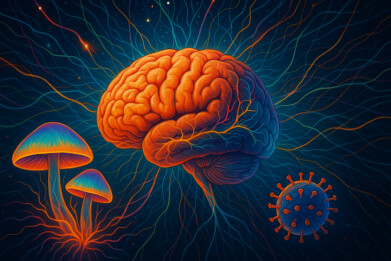
An international team led by Cornell University has used a modified rabies virus to trace how psilocybin reshapes brain-wide connectivity, weakening harmful feedback loops and strengthening pathways that link perception to action, with potential to refine psychedelic therapies for depression
Cornell University researchers have led an international collaboration that has used a combination of psilocybin and a modified rabies virus to map how the psychedelic compound rewires neural circuits in the brain and where those changes occur. The work has provided some of the clearest evidence to date that psilocybin weakens higher-order feedback loops that can trap people in persistent negative thought patterns and strengthens pathways that connect sensory input to action.
The team reported that psilocybin weakened cortico-cortical feedback loops, which link different regions of the cerebral cortex and can reinforce rigid thinking in cases of depression. In parallel, the drug strengthened projections from cortical sensory areas to subcortical regions that transform perception into behaviour. These subcortical hubs integrate sensory information and influence motor output, so enhanced connectivity at these sites appears to amplify sensory–motor responses.
The project is the latest in a series of studies to be led from the laboratory of Professor Alex Kwan, a biomedical engineer at Cornell University, Ithaca, New York, USA. Kwan’s group investigates how psychiatric drugs such as psilocybin, ketamine and 5-methoxy-N,N-dimethyltryptamine (5-MeO-DMT) alter neural circuitry, with the long-term aim to develop more precise and more durable treatments for mood disorders, including major depressive disorder.
Psilocybin, the psychoactive ingredient in ‘magic mushrooms’, has attracted intense pharmaceutical interest because clinical trials have shown that a single, carefully supervised dose can reduce depressive symptoms for weeks and in some cases months. However, despite these striking clinical effects, the field has lacked detailed maps of how the compound reshapes neural networks at the level of whole-brain connectivity.
“With psilocybin, it is as if we add all these roads to the brain, but we do not know where the roads go,” said Kwan.
“Here we use the rabies virus to read out the connectivity in the brain, because these viruses are engineered in nature to transmit between neurons.
“That is how they are so deadly. The virus jumps a synapse and goes from one neuron to another,” he added.
In this study, the team harnessed that property in a controlled way, using a modified, laboratory-safe form of the virus as a tracer to reveal which neurons gained or lost connections after exposure to psilocybin.
When the researchers examined the resulting connectivity patterns, they saw that sensory areas of the cortex had formed stronger links to subcortical regions that help convert perception into action. This shift suggests that psilocybin biases the brain away from self-referential loops that recycle internal thoughts and towards circuits that prioritise immediate sensory input and behaviour. In clinical terms, such a tilt could help patients disengage from entrenched, negative self-talk and re-engage with the external world.
Kwan initially expected to see psilocybin reshape communication between one or two specific brain regions that earlier work had implicated in depression. Instead, the analysis revealed that the compound altered connectivity across much of the brain, with widespread shifts in long-range projections.
“This is really to look at brain-wide changes. That is a scale that we had not worked at before. A lot of times, we focus on a small part of the neural circuit,” he said.
By combining systemic psilocybin administration with whole-brain viral tracing, the team could move beyond local snapshots and capture the broader pattern of neural reconfiguration.
The extensive connectivity maps also indicated that the level of firing activity in a given region might influence which synaptic pathways psilocybin ultimately remodelled. Regions that showed particular patterns of activity before or during treatment appeared more likely to undergo structural and functional change. This observation raised a crucial mechanistic question: if scientists could adjust the activity of a specific brain area during psilocybin exposure, could they steer how the drug rewired that circuit?
To test that idea, the researchers perturbed and controlled neural activity in a targeted brain region while animals received psilocybin. They then repeated the rabies-based tracing. By directly manipulating the firing patterns in that region, they found that they could shift the way psilocybin redistributed its synaptic effects across the wider network, effectively reshaping the rewiring pattern.
“That opens up many possibilities for therapeutics, how you maybe avoid some of the plasticity that is negative and then enhance specifically those that are positive,” said Kwan.
In principle, such an approach could lead to protocols that combine psychedelic compounds with non-invasive brain stimulation, behavioural tasks or sensory cues to guide this brain neo-plasticity into clinically desirable channels.
Although the present work has remained in preclinical models, the strategy to pair a psychedelic drug with a powerful viral tracer has provided an unusually detailed view of how psilocybin alters communication among distant brain regions. The findings help to explain how a short-lived pharmacological intervention can trigger long-lasting changes in mood and cognition, and they point to ways in which future therapies might fine-tune those effects.
For further reading please visit: 10.1016/j.cell.2025.11.009



Digital Edition
Lab Asia Dec 2025
December 2025
Chromatography Articles- Cutting-edge sample preparation tools help laboratories to stay ahead of the curveMass Spectrometry & Spectroscopy Articles- Unlocking the complexity of metabolomics: Pushi...
View all digital editions








Events
Jan 21 2026 Tokyo, Japan
Jan 28 2026 Tokyo, Japan
Jan 29 2026 New Delhi, India
Feb 07 2026 Boston, MA, USA
Asia Pharma Expo/Asia Lab Expo
Feb 12 2026 Dhaka, Bangladesh




