-

-
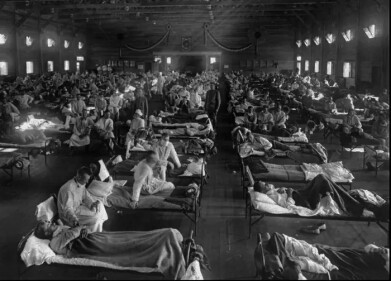 Influenza victims crowded into an emergency hospital near Fort Riley, Kansas in 1918. Credit: AP Photo National Museum of Health
Research news
Yale study places long COVID among an extensive history of post-acute infection syndromes
Dec 09 2025
Scientists at Yale School of Medicine have argued that long COVID belongs to a long-established family of post-acute infection syndromes, and that historical records of past epidemics can guide efforts to understand mechanisms, reduce stigma, and develop effective treatments
A research team from the Yale School of Medicine, New Haven, Connecticut, USA has highlighted the status of long COVID in the wider context of post-acute infection syndromes and other chronic illnesses that follow infections. In a recent paper, the authors argued that careful study of long COVID alongside historical accounts of earlier epidemics can provide crucial perspective on the profound and long-lasting effects of these conditions and can help to inform more effective interventions to prevent and treat them.
“Post-acute infection syndromes are a long-overlooked but important area of medicine, and long COVID represents a contemporary manifestation of a phenomenon that has been described for more than a century,” said co-author Dr Christine Miller of Yale School of Medicine.
She added that clinicians across generations have reported patients who fail to return to their baseline health after an acute infection, yet medicine has often treated these cases as curiosities rather than as a coherent, biologically grounded group of conditions.
“Recognising that these conditions are not a recent phenomenon reframes long COVID within a broader historical and biological context and emphasises the urgent need to understand their mechanisms,” said Dr Miller.
By placing long COVID on a continuum with other post-acute infection syndromes, she argued, researchers can avoid the impression that it is an entirely unprecedented disorder and instead draw on a richer body of clinical observation and scientific theory.
Across history, outbreaks of infectious disease, from influenza to poliomyelitis, have left a subset of patients with persistent, often unexplained symptoms long after the initial infection has resolved. The paper describes how these symptoms have included severe fatigue, shortness of breath, neurocognitive and sensory problems, and pain in muscles and joints. For many people, the authors noted, these sequelae have been disabling and have disrupted work, education and family life.
Yet the biological mechanisms that trigger and maintain such symptoms have remained unclear, which has limited the development of diagnostic tests and targeted treatments.
“The greatest challenge to develop treatments for long COVID is to understand the underlying pathobiology,” said co-author Dr. Janna Moen, a post-doctoral researcher into neurobiology, at Yale School of Medicine.
“Several hypotheses exist, from viral persistence to immune dysregulation. But without a better understanding, diagnostic tests and targeted therapies are difficult to design,” she added.
The authors have emphasised that these hypotheses are not mutually exclusive and that different mechanisms may dominate in different individuals or at different stages of illness.
To gain historical insight, the team examined major epidemics in modern history in which post-acute symptoms had been well documented, including the influenza pandemics of the late 19th and early 20th centuries. Their aim was not to compile a comprehensive catalogue of every outbreak or syndrome but to illustrate a recurring pattern across pathogens and time periods that highlights shared features of post-acute infection syndromes.
These patterns, they argued, include the tendency for symptoms to arise after an apparently typical acute illness, the difficulty of demonstration of persistent organ damage with routine tests and the consequent tendency for patients to face scepticism or stigma.
“One surprising finding was how closely historical descriptions of post-influenza exhaustion from the 1889–1890 epidemic mirror modern accounts of long COVID,” said Dr Miller.
“Reading physicians’ notes from that era felt almost indistinguishable from today’s clinical reports,” said Miller.
The paper notes that doctors more than a century ago described patients who experienced prolonged fatigue, cognitive difficulties, disturbed sleep, and heightened sensitivity to exertion, in language that resonates strongly with contemporary case reports of long COVID.
“We were also surprised to find how frequently children were affected. These syndromes are often discussed in the context of adult illness, but historical accounts highlight that paediatric populations are also vulnerable to these long-term effects,” Dr Miller said.
The authors have suggested that recognition of childhood susceptibility should influence future study design, service planning, and discussions of long-term educational and developmental consequences.
The authors have outlined a multi-pronged strategy to investigate leading hypotheses about the mechanisms that underlie post-acute infection syndromes. They have combined data from diverse patient cohorts, including individuals with long COVID and related conditions, with detailed analysis of biospecimens such as blood and tissue samples, and with experimental work in animal models.
By integration of clinical observations with mechanistic studies, the team aims to identify biological pathways that could serve as targets for disease prevention or treatment across different post-acute infection syndromes, rather than for long COVID alone.
“We hope this paper raises awareness about the prevalence and continuum of post-acute infection syndromes [in a historical context] preceding long COVID,” said co-author Professor Akiko Iwasaki of Yale School of Medicine.
“By situating long COVID within the history of post-infectious illnesses, we aim to reduce stigma and encourage coordinated efforts to develop effective treatments,” she added.
Iwasaki argued that a clearer sense of continuity with past epidemics may help health systems to plan for long-term care, guide funding agencies to support sustained research programmes, and reassure patients that their experiences fit within a recognisable medical framework.
The Yale team has concluded that long COVID should be understood as part of a broader class of post-acute infection syndromes that medicine has often under-recognised. By drawing on more than a century of clinical experience and by coupling historical analysis with contemporary laboratory science, they have argued that researchers and clinicians can move closer to robust diagnostic criteria, credible biological models, and ultimately therapies that relieve the long-term burden of infection-associated chronic illness.
For further reading please visit: 10.1016/j.it.2025.10.010



Digital Edition
Lab Asia Dec 2025
December 2025
Chromatography Articles- Cutting-edge sample preparation tools help laboratories to stay ahead of the curveMass Spectrometry & Spectroscopy Articles- Unlocking the complexity of metabolomics: Pushi...
View all digital editions










Events
Jan 21 2026 Tokyo, Japan
Jan 28 2026 Tokyo, Japan
Jan 29 2026 New Delhi, India
Feb 07 2026 Boston, MA, USA
Asia Pharma Expo/Asia Lab Expo
Feb 12 2026 Dhaka, Bangladesh




