News
What's So Special About Neutron Stars?
Feb 12 2016
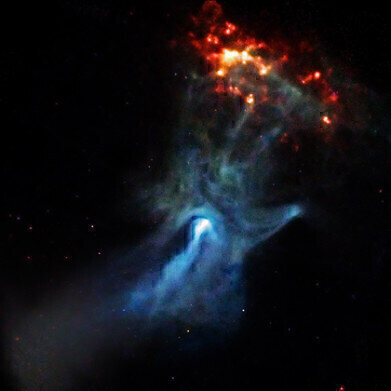
NASA is continually capturing revolutionary new data from outer space, with an image from its Chandra X-ray Observatory just emerging as the latest photograph to get scientists buzzing. To the untrained eye the image looks like a kaleidoscopic jellyfish, or a colourful interpretation of the milky way. To space scientists, the phenomenon is known as PSR B1509-58. The very young and hugely powerful pulsar is essentially made up of super-dense stellar remnants. It measures in at just twelve miles in diameter, which makes it a significantly small neutron star when compared to its larger counterparts.
A cosmic gift
So what makes these neutron stars so special? Scientists have referred to them as a “cosmic gift” that spans 150 light years. The stars spin at a rapid rate which causes them to spew out energy into surrounding space. This creates complex, intriguing and intrinsically beautiful patterns. As well as the aesthetic value, the electromagnetic energy pulses offer fascinating insight into the nature of the interstellar medium, and the complexities of space-time itself. They also create gold upon collision, and offer space scientists a glimpse at a myriad of different physics spectacles.
The concept was recently explored in further detail by McGill University’s Victoria Kaspi. She took to the stage as part of the Perimeter Institute Lecture on neutron stars, describing the collapsed plasma spheres as “A celestial gift to scientists.”
Beacons for modern physics
“These incredibly dense collapsed stars act as very precise cosmic beacons that help shed light on some of the most challenging problems in modern physics,” reads the description of her presentation. It goes on to describe her talk as an exploration of the strange objects that delves into “How astronomers are using them to study issues ranging from the origins of the universe to the very nature of matter, and even let the audience hear the cosmic symphony they create.
“I love understanding,” says Kaspi. “I love when a puzzle suddenly comes together. And it’s nice to be able to share that kind of discovery.”
The field of kinetics is an intrinsic part of space science. Explore the study of movement in further detail in the article, ‘Kinetics Measurements with High Sensitivity Spectroscopy ‘Chemical Stoplight’ Reaction Monitoring.’ It examines the critical role kinetics plays in measuring the rate and mechanism of the chemical reactions that occur all around us, from inside the cells of the human body to the atmospheric ozone layer.
Image via Flickr Creative Commons. Photo credits: NASA Blueshift




Digital Edition
Lab Asia Dec 2025
December 2025
Chromatography Articles- Cutting-edge sample preparation tools help laboratories to stay ahead of the curveMass Spectrometry & Spectroscopy Articles- Unlocking the complexity of metabolomics: Pushi...
View all digital editions










Events
Jan 21 2026 Tokyo, Japan
Jan 28 2026 Tokyo, Japan
Jan 29 2026 New Delhi, India
Feb 07 2026 Boston, MA, USA
Asia Pharma Expo/Asia Lab Expo
Feb 12 2026 Dhaka, Bangladesh




