-
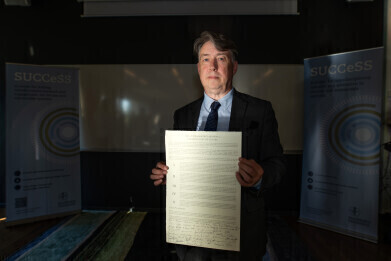 Paul Anastas, professor of chemistry at Yale University and and senior advisor for Stockholm University Center for Circular and Sustainable Systems, with the signed text of the Stockholm Declaration. Credit: Photo: Liisa Eelsoo
 -
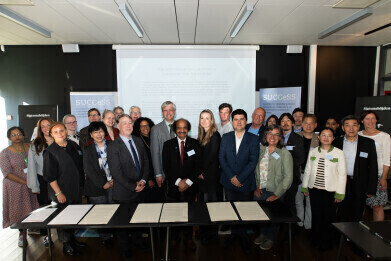 Participants at the Nobel symposium when signing the declaration. Photo: Liisa Eelsoo
 -
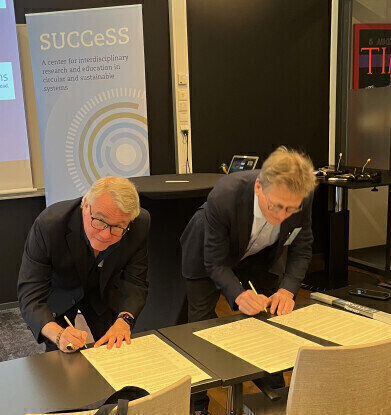 [From left] Professor Ben Feringa, of the University of Groningen and Nobel laureate in chemistry in 2016, signs the declaration alongside Professor Walter Leitner of the Max Planck Institute for Chemical Energy Conversion Credit: Photo: Liisa Eelsoo
 -
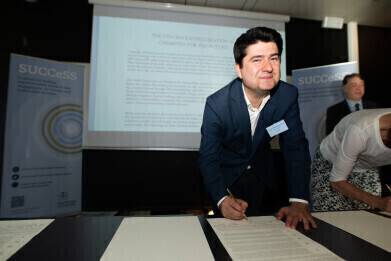 Professor Javier García Martínez of University of Alicante. Credit: Photo: Liisa Eelsoo
 -
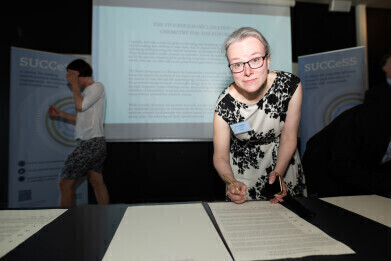 Professor Helen Sneddon of York University signing the declaration. Credit: Photo: Liisa Eelsoo
News
Declaration at Nobel Museum calls for urgent action to make chemistry more sustainable
Jun 02 2025
Chemistry must urgently evolve to become more sustainable. This is the central message of the Stockholm Declaration on Chemistry for the Future, launched on 23 May at the Nobel Prize Museum in Stockholm.
The declaration was developed ahead of the Nobel Symposium on Chemistry for Sustainability: Fundamental Advances, held from 19 to 22 May 2025 near Stockholm. Organised by Stockholm University’s Centre for Circular and Sustainable Systems (SUCCeSS), the event brought together around thirty leading international researchers in sustainable chemistry, alongside thirty invited participants from Swedish academia and industry. The aim was to explore how chemistry can contribute more effectively to achieving the United Nations Sustainable Development Goals (SDGs).
The Stockholm Declaration on Chemistry for the Future was co-authored by the symposium speakers with contributions from SUCCeSS. A formal signing ceremony took place during the event, and a digital platform for further signatories was subsequently launched.
The declaration underscores that chemistry has historically played a pivotal role in advancing human well-being, but it has also resulted in unintended harm to both people and the planet. It argues for a transformation in how chemistry is practised, calling for safe and sustainable chemical products that prioritise complete material and energy use, renewable resources, and integrative systems thinking.
To drive this shift, the declaration outlines five essential actions:
Embed goals that reduce or eliminate harm to people and the environment within all chemical products and processes.
Act immediately. The risks of inaction outweigh the challenges of transition.
Train teachers, students and practitioners to prioritise sustainability and health in their work.
Ensure open access to chemical data and information to promote transparency.
Align government policies on chemistry with sustainability and public health.
The declaration calls on scientists, industry leaders, educators, students and policymakers to work together to implement practical solutions that advance human well-being while safeguarding the planet. “By embracing this vision, we can harness chemistry’s full potential as a catalyst for a fairer, more sustainable and resilient world,” the document states.
Professor Paul Anastas of Yale University, who also serves as senior adviser at SUCCeSS, has led the initiative.
“The essence of the Stockholm Declaration is the imperative of transforming invention into impact by unleashing the power of chemistry to improve people’s lives through large-scale implementation,” he said.
Among the signatories is Professor Ben Feringa, Nobel laureate in Chemistry (2016) and professor at the University of Groningen. Speaking at the launch, he noted: “The Stockholm Declaration is an urgent call to join forces to re-invent chemistry in order to build our sustainable future. Chemistry as the ‘creating and central science’ will make the difference in society and industry in the years ahead, teaching our young talents and providing breakthrough discoveries for sustainable innovations.”
Professor Berit Olofsson, co-director of SUCCeSS and professor of organic chemistry at Stockholm University, emphasised the importance of the symposium itself: “The organisation of the Nobel Symposium on Chemistry for Sustainability: Fundamental Advances was an important milestone for SUCCeSS. We are proud to be closely connected to this important declaration, which will have a large impact on re-inventing chemistry towards a sustainable future.”
The declaration remains open for endorsement and invites those working in chemistry to read, sign and share its message.
The full text of the declaration is below:
THE STOCKHOLM DECLARATION ON CHEMISTRY FOR THE FUTURE
"Currently, scientists around the globe are inventing and developing new molecules and materials, and are creating new methods to make them, that are aligned with the goals of advancing human well-being while preserving the essential biosphere and geosphere that allows life to exist and thrive. These fundamental scientific advances are imperative because the traditional approaches to chemistry for the past two centuries, while producing tremendous technological breakthroughs and great wealth, have also too often still caused unintentional great harm to people and the planet.
The Nobel Symposium on Chemistry for Sustainability convened scientists driving chemistry for the future that ensures the products of our science are safe and sustainable by design, virtually eliminate the concept of waste through full material/energy utilization, utilize non-depleting materials, enable the generation/storage/transport of renewable energy, provide functional performance, designed through integrative systems thinking, and are dynamic/adaptable/resilient/multifunctional. The chemistry of sustainability recognizes that sustainability without innovation is impossible and innovation without sustainability would be ruinous.
While scientific discovery and invention is crucial, it is also not sufficient by itself. The signatories of this Stockholm Declaration on Chemistry for the Future recognize the range of elements needed to transform scientific breakthroughs into positive impact for society and the ecosystems upon which society relies. The following are those essential elements.
I
For the future, we must ensure that our design, development, and implementation of chemical products and processes proceed in a manner that integrates the goal of reducing or eliminating harm to people and the planet by design. Our businesses must ensure either design for inherently safe and rapid degradation for chemicals/materials with a dispersive use or design for disassembly of chemicals/materials with the potential for a circular use. Our chemical processes must evolve from reliance on substances that are toxic, depleting, rare, persistent, and explosive/flammable to substances that are healthful, renewable, distributed, plentiful, unreactive, and degradable. Our manufacturing must largely evolve from being efficient to being effective, from being centralized, single-purpose, built-to-last facilities to being distributed, adaptable/dynamic, continuous, and inherently safe.
II
For the future, all parts of our chemical enterprise must act now to recognize that the risk to people, prosperity, and the planet from inaction and preservation of the status quo is far greater than any risks that may be involved with transitioning to a ‘new chemistry for sustainability’ model that brings benefit to people, prosperity, and the planet. Our companies must now recognize and disclose the use and generation of chemical hazards as a material vulnerability to shareholders and investors. Our investment models and mechanisms must fully incorporate the risks to investment posed by the use or generation of hazardous substances and account for them as part of due diligence. It is imperative to develop and adequately consider both qualitative and quantitative metrics in evaluating the concerns or benefits of chemicals both individually and as part of complex mixtures; recognizing that the ease of quantification is not a measure of importance.
III
For the future, our teachers, students, and practitioners of chemistry need to be trained now to ensure that the invention of new chemicals or chemical transformations integrates health, sustainability, and inherent safety as essential elements of performance. Our education at all levels must now include systems-thinking and life-cycle perspectives to allow for designing chemistry that will interconnect and be appropriate across supply chains, geographies, socioeconomic strata, cultures, industry sectors, ecosystems, and time.
IV
For the future, data and information of high quality and reliability on chemicals are essential to inherently safe and sustainable innovation and impact assessment. As such, chemical data and information must now be fully available and accessible to all; any efforts to withhold chemical information should be subject to the highest justifications and scrutiny. Transparency on the underlying data and analysis of the advantages and disadvantages of a new or legacy chemical technology must be ensured to allow for adequate comparisons without concern for exaggeration or bias.
IV
For the future, we must act now to ensure that our governmental policies on the chemical enterprise including subsidies, regulations, tax incentives, protections, or penalties be aligned with advancing healthful and safe chemistry and disincentivizing/displacing polluting, wasteful, toxic, dangerous chemistry. Our regulatory policy and advanced assessment methodologies must now be implemented to advance the transition to sustainable chemicals and chemical technology without inadvertently preserving and extending legacy unsustainable chemistry.
CALL TO ACTION
Purposeful chemistry is focused on ethical, sustainable, and innovative solutions to global challenges. The Stockholm Declaration on Chemistry for the Future is a call to action urging scientists, industry, educators, students, and policy makers to collaborate on implementing solutions for human well-being while preserving and protecting our environment. By embracing this vision, we can harness chemistry’s full potential as a catalyst for a fairer, more sustainable, and resilient world.
The imperatives listed above will only be realized by the collective action of those who recognize the essential role of chemistry in creating a society that is conducive to all life now and into the future. The call of this Declaration to individuals, organizations, institutions, and communities is to come together and engage in implementing these elements to bring about a positive transformative impact for our planet and for the well- being of generations to come."
YOU CAN SIGN THE DECLARATION HERE



Digital Edition
Lab Asia Dec 2025
December 2025
Chromatography Articles- Cutting-edge sample preparation tools help laboratories to stay ahead of the curveMass Spectrometry & Spectroscopy Articles- Unlocking the complexity of metabolomics: Pushi...
View all digital editions










Events
Jan 21 2026 Tokyo, Japan
Jan 28 2026 Tokyo, Japan
Jan 29 2026 New Delhi, India
Feb 07 2026 Boston, MA, USA
Asia Pharma Expo/Asia Lab Expo
Feb 12 2026 Dhaka, Bangladesh




