News
Manganese-based MOF contrast agent offers novel, greener alternative to gadolinium in MRIs
Nov 19 2025
Oregon State University team has developed BVR-19, a contrast agent made from a manganese-based metal–organic framework – the technology which won the 2025 Nobel Prize in Chemistry – that has the potential to deliver brighter magnetic resonance imaging at lower doses, reducing toxicity, and easing supply chain pressures, while cutting environmental impact from gadolinium waste
Scientists at Oregon State University (OSU), in the United States, have developed a novel magnetic resonance imaging (MRI) contrast agent that has the potential to outperform current products while reducing toxicity for patients and cutting impact on the environment.
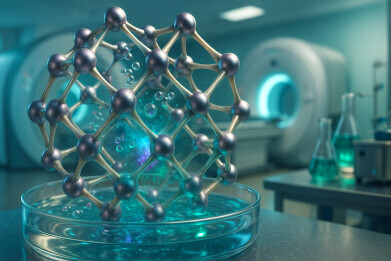
The material is based on a structure known as a metal–organic framework (MOF) – the chemistry technology developed in the 1990s which was recognised by the 2025 Nobel Prize in Chemistry awarded to Kitagawa, Robson and Yaghi.
MOFs consist of positively charged metal ions linked by organic molecules to form a rigid, highly ordered lattice. The framework contains nanosized pores and chemists can select both the metal centres and the organic linkers to tailor properties such as stability, solubility and magnetic behaviour.
Professor Kyriakos Stylianou led the team from OSU College of Science, Corvallis, Oregon, which has developed a manganese-based MOF called BVR-19, which they propose as a promising alternative to current gadolinium-based MRI contrast agents. The BVR part of the name derives from ‘beaver’ which is the mascot of OSU.
A contrast agent, also known as a contrast medium, is a substance that enhances the visibility of tissue during medical imaging in order to distinguish healthy from diseased structures. The global market for MRI contrast agents has an estimated value of more than US$1.5 billion and is forecast to grow by a further US$750 million over the next five years. Demand for non-invasive diagnostic procedures is expanding worldwide.
MRI contrast agents most widely rely on gadolinium which is a rare earth element. Although these products have transformed diagnostic imaging, gadolinium has raised concerns about toxicity in patients, potential harm to aquatic and terrestrial ecosystems, and the resilience of global supply chains. China controls many of the world’s rare earth reserves and much of its associated processing and production capacity.
Manganese, by contrast (forgive the pun), is abundant in the Earth’s crust and already underpins a range of industrial applications that include batteries, steel and ceramics. In addition, manganese is an essential trace element in human biology; it supports antioxidant defence mechanisms, bone formation and the metabolism of cholesterols, carbohydrates and amino acids.
“BVR-19 represents a paradigm shift in MRI contrast agent design,” said Stylianou, who directs OSU’s Materials Discovery Laboratory (MaD Lab).
“We’re replacing toxic metals with abundant, biocompatible ones, without compromising performance,” he said.
Gadolinium-based contrast agents have been in routine clinical use for nearly 40 years. After administration, the human body does not metabolise these agents. They pass largely unchanged into wastewater systems and resist degradation in conventional water treatment plants. Their long-term ecotoxicological effects are not well understood and trace levels of gadolinium have already been detected in surface waters and sediments in several countries.
However, there is growing concern about the retention of gadolinium in the body. Most clinically approved agents are designed to be excreted within 24 hours of administration, yet studies have shown that gadolinium deposits can persist in tissues such as bone and brain for months or years, even in patients with normal kidney function. Although retention has not been conclusively linked to specific diseases, the United States Food and Drug Administration (FDA) has issued safety communications and now requires that patients receive information about gadolinium retention because of ongoing uncertainty about long-term consequences.
Stylianou and colleagues have reported that BVR-19 is the first manganese-based MOF to incorporate L-cystine, a naturally occurring, biocompatible amino acid. The synthesis proceeds in water at room temperature, without toxic solvents or other harsh reaction conditions, which aligns the process with principles of green chemistry.
Laboratory tests have indicated that BVR-19 can produce brighter and clearer MRI images at lower doses than those required for currently available clinical agents which could reduce the amount of metal exposure per patient.
“This work underscores OSU’s leadership in designing functional MOFs for medical and environmental applications and demonstrates how green chemistry and materials design can converge to create safer technologies.
“It bridges chemistry, toxicology and medicine, showing how collaboration across disciplines can transform fundamental discoveries into technologies that directly improve human health,” he said.
The research has highlighted how MOFs, previously associated primarily with gas storage, catalysis and separation processes, may also provide a versatile platform for other biomedical purposes alongside uses as imaging agents. By selecting different metal centres and biocompatible linkers, scientists could in principle fine-tune properties such as relaxivity, stability in biological fluids and clearance pathways, which are critical for clinical translation.
Jacob Lessard, a doctoral candidate and undergraduate researcher Dylan Pyle were first authors of the study. Other contributors from the MaD Lab included postdoctoral fellow Dr. Andrzej Gladysiak, Emmanuel Musa, a doctoral candidate and undergraduate Jeff Bowen. The team has now secured intellectual property protection through a patent application and has indicated that further preclinical work will be necessary to evaluate BVR-19’s safety, pharmacokinetics and performance in animal models before any move towards human trials.
For further reading please visit: 10.1039/D5TB01711D

Digital Edition
Lab Asia Dec 2025
December 2025
Chromatography Articles- Cutting-edge sample preparation tools help laboratories to stay ahead of the curveMass Spectrometry & Spectroscopy Articles- Unlocking the complexity of metabolomics: Pushi...
View all digital editions







Events
Jan 21 2026 Tokyo, Japan
Jan 28 2026 Tokyo, Japan
Jan 29 2026 New Delhi, India
Feb 07 2026 Boston, MA, USA
Asia Pharma Expo/Asia Lab Expo
Feb 12 2026 Dhaka, Bangladesh