-
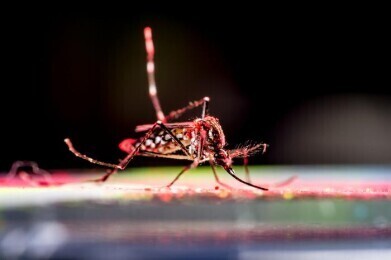 An Aedes aegypti mosquito with red powder used to mark the animal in a behavior test. Credit: Matt Cashore/University of Notre Dame
News
Chikungunya virus outbreak defies prediction as global study challenges links to climate
Oct 23 2025
A large-scale study by the University of Notre Dame has reconstructed more than 80 chikungunya virus outbreaks to reveal that their local conditions – and broadly not climate – best explain the severity of transmission
Health officials have warned that chikungunya virus outbreaks begin swiftly, typically marked by acute fever followed by severe joint pain that may persist for months. Though rarely lethal, the virus can cause particularly serious outcomes in high-risk groups such as newborns and elderly people. Transmission occurs via mosquitoes, primarily Aedes aegypti and Aedes albopictus.
Endemic across tropical and subtropical zones in Asia, Africa and South America, chikungunya is now beginning to appear beyond those regions. Public health authorities have noted reported cases in Europe and in September of 2025 a confirmed case emerged on Long Island, New York.
The United States’ Centers for Disease Control and Prevention issued health notices advising travellers travelling to Bangladesh, Cuba, Guangdong Province in China, Kenya, Madagascar, Somalia and Sri Lanka to take precautionary measures.
In Guangdong Province, an ‘unprecedented’ outbreak led Chinese authorities to mandate quarantine for suspected cases, to apply mosquito repellent to individuals, and to spray insecticide across affected buildings and surrounding areas.
Researchers at the University of Notre Dame, Notre Dame, Indiana, have now published a study that analysed more than 80 chikungunya outbreaks in order to help improve the prediction of future events and inform any vaccine trials. Their analysis represented the largest comparative dataset of chikungunya transmission constructed to date.
“Outbreaks vary dramatically in scope and intensity. Some infect only a handful of people while others devastate tens of thousands in similar settings,” said Dr. Alex Perkins, Ann and Daniel Monahan Collegiate Professor of infectious disease epidemiology at Notre Dame and co-author of the study.
He added that such unpredictability has complicated public health planning and vaccine development.
“Instead of looking at outbreaks in isolation, analysing many together, all varying in size and severity, allowed us to search for patterns across them,” said Dr. Alexander Meyer, a postdoctoral researcher in Perkins’ laboratory and the study’s lead author, in describing the team’s methodological approach.
The researchers reconstructed and examined 86 chikungunya outbreaks, spanning a wide range of geographical and epidemiological contexts. By fitting mechanistic transmission models to each outbreak, they estimated characteristic parameters such as the basic reproduction number and generation interval. Then using machine-learning techniques the team assessed how well climatic, demographic and other predictors could forecast outbreak severity.
Although climatic variables such as temperature and rainfall are known to influence where outbreaks may occur, the team found that those factors had limited predictive value for determining how severe outbreaks would become. Local conditions such as housing quality, mosquito density and community response exerted stronger influence. In addition, random variation accounted for a considerable portion of the differences between outbreaks.
“Climate factors can tell us where outbreaks are possible but they do not help much in predicting how severe they will be. Local conditions matter and some variation is simply due to chance. That randomness is part of the story too,” explained Perkins.
The chikungunya virus was first identified in 1952 in Tanzania – then known as Tanganyika during an outbreak on the Makonde Plateau – and has seen increasing incidence and geographical spread in recent decades, though its outbreaks remain sporadic and difficult to forecast.
The link between climate change and mosquito-borne diseases has attracted considerable attention, since warmer, more humid environments tend to favour vector activity. However, the Notre Dame study indicated that climate alone cannot explain the variation in outbreak outcomes.
At present, only two chikungunya vaccines have received regulatory approval but their availability remains limited in the regions most affected by the virus. The researchers noted that improved predictive models are critical for vaccine efficacy trials which require suitable trial sites to be identified before outbreaks occur, so that candidate vaccines can be tested under natural exposure conditions.
By providing a broad, comparative perspective on past outbreaks, the research offers a valuable tool for public health officials to anticipate future outbreaks, allocate resources more effectively and protect vulnerable populations, while offering vaccine developers a clearer framework for trial planning.
For further reading please visit: 10.1126/sciadv.adt5419




Digital Edition
Lab Asia Dec 2025
December 2025
Chromatography Articles- Cutting-edge sample preparation tools help laboratories to stay ahead of the curveMass Spectrometry & Spectroscopy Articles- Unlocking the complexity of metabolomics: Pushi...
View all digital editions










Events
Jan 21 2026 Tokyo, Japan
Jan 28 2026 Tokyo, Japan
Jan 29 2026 New Delhi, India
Feb 07 2026 Boston, MA, USA
Asia Pharma Expo/Asia Lab Expo
Feb 12 2026 Dhaka, Bangladesh




