-
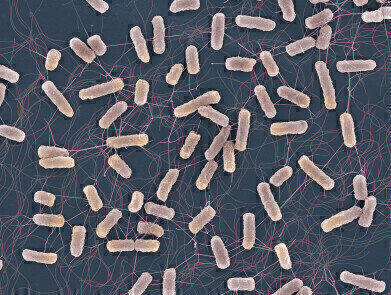 Scanning-electron microscopy image showing salmonella bacteria. Credit: University of Basel, Biozentrum/Swiss Nanoscience Institute, nano imaging laboratory
Research news
Why antibiotics can fail even against non-resistant bacteria
Feb 24 2025
Antibiotics are an indispensable tool for treating bacterial infections. But why are they sometimes ineffective, even when the bacteria being treated are not resistant? Researchers from the University of Basel have challenged the conventional wisdom that a small subset of resilient bacteria are responsible for the failure of antibiotic therapies.
In some infectious disease caused by bacteria, antibiotics demonstrate less effectiveness than would be expected. One example is infections caused by Salmonella bacteria, which can lead to illnesses such as typhoid fever. For many years, researchers believed that a small subset of dormant bacteria are the main problem in fighting infections. These so-called ‘persisters’ can survive antibiotic treatment and cause later relapses. Researchers worldwide have been working on new therapies aimed at targeting and eliminating these ‘sleeping’ bacteria.
In this study, Professor Dirk Bumann’s team from the Biozentrum of the University of Basel have challenged the prevailing concept that persisters are the cause of antibiotic ineffectiveness.
“Contrary to widespread belief, antibiotic failure is not caused by a small subset of persisters. In fact, the majority of Salmonella in infected tissues are difficult to kill,” explains Bumann. “We have been able to demonstrate that standard laboratory tests of antimicrobial clearance produce misleading results, giving a false impression of a small group of particularly resilient persisters.”
The researchers investigated antimicrobial clearance in both Salmonella-infected mice and tissue-mimicking laboratory models. The body’s defence mechanisms against bacteria often include reducing the availability of nutrients. The researchers have now revealed that in fact, this nutrient starvation is the main reason for Salmonella bacteria surviving treatments with antibiotics.
The researchers assume that the same applies to other bacterial pathogens.
“Under nutrient-scarce conditions, bacteria grow very slowly,” says Bumann.
“This may seem good at first but is actually a problem because most antibiotics only gradually kill slowly growing bacteria.” As a result, the drugs are much less effective and relapses can occur even after prolonged therapy.
The team used innovated a method to monitor antibiotic action on individual bacteria in real time. “We demonstrated that nearly the entire Salmonella population survives antibiotic treatment for extended periods, not just a small subset of hyper-resilient persisters,” says Dr. Joseph Fanous, the study’s first author.
A major problem highlighted by the study, when considering the standard methods that are used worldwide – and have been for decades – is the indirect and delayed measurement of bacterial survival. This study has shown it leads to distorted results.
“Traditional tests underestimate the number of surviving bacteria,” explains Fanous.
“And they falsely suggest the presence of hyper-resilient subsets of persisters that do not actually exist.” This misinterpretation has influenced research for many years. These findings could fundamentally change antibiotics research.
“Our work underlines the importance of studying bacterial behaviour and antibiotic effects live and under physiologically relevant conditions,” emphasised Bumann.
“In a few years, modern methods like real-time single-cell analysis will hopefully become standard.” Shifting the focus from persisters to the impact of nutrient starvation is an important step toward more effective therapies against difficult-to-treat infections.
For further reading please visit: 10.1038/s41586-024-08506-6


Digital Edition
Lab Asia Dec 2025
December 2025
Chromatography Articles- Cutting-edge sample preparation tools help laboratories to stay ahead of the curveMass Spectrometry & Spectroscopy Articles- Unlocking the complexity of metabolomics: Pushi...
View all digital editions








Events
Jan 21 2026 Tokyo, Japan
Jan 28 2026 Tokyo, Japan
Jan 29 2026 New Delhi, India
Feb 07 2026 Boston, MA, USA
Asia Pharma Expo/Asia Lab Expo
Feb 12 2026 Dhaka, Bangladesh




