Laboratory products
Lenton is playing a vital role in the successful development and manufacture of revolutionary orthobiological synthetic bone graft materials created by a number of European developers.
From the outset Lenton furnaces have been used to develop and manufacture a number of these innovative orthobiologic graft products. Central to this revolution in bioceramics is the ability to produce a particle stabilised ceramic slip foam with a carefully engineered pore structure and chemistry. The material’s structure is critically dependent on the particle size distribution coupled with the accurate heating and sintering of the foam within the Lenton furnaces used for production.
The porosity and nanoscale surface chemistry of the final orthobiological synthetic bone graft materials has to be tailored to the most exact requirements. Silicates substituted for a proportion of the phosphate groups within the hydroxyapatite foam produce a material with high levels of macro-porous connectivity, which not only provides a scaffold that osteoblasts can colonise but also induces a level of biostimulation to accelerate natural bone growth.
Multiple energy efficient Lenton furnaces are being used for batch manufacture of the graft material and provide economical heating via silicon carbide heating elements controlled by multi-segment programmable controllers which log data via RS232 communication links from the sintering process to the control computer.
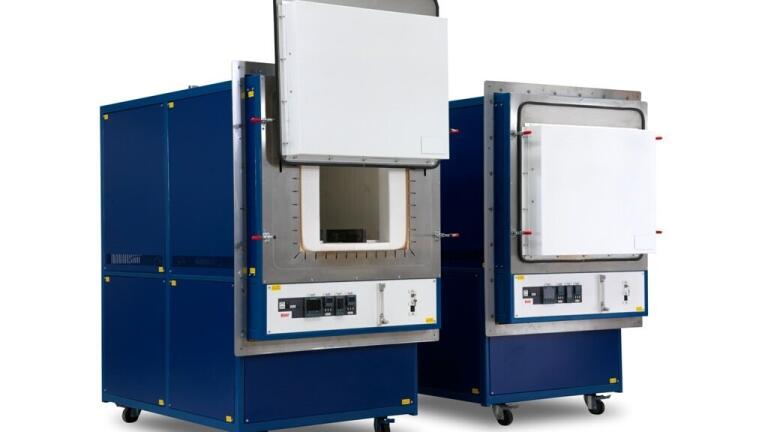
As production demands have grown, there has been demand for Lenton to design and build progressively larger capacity, custom made furnaces increasing from 50 to 100 litre models, to latterly 200 litre capacity systems.
With a maximum temperature of 1350°C the valuable loads and the furnaces themselves are protected by independent over temperature protection thermostats. Within the chambers silicon carbide support beams facilitate trolley loading of the chambers. The furnace doors open upwards to provide easy access to the chambers and keep the hot face of the doors away from the operator. Once closed, clamps hold the doors securely shut to prevent ingress of the positively pressurised cleanroom air, whilst a separate air supply is fed into the furnace chambers and drawn away though Venturi exhaust systems under the control of the programmers but with a manual override option.


.jpg)
-(2).jpg)