Laboratory news
CRISPR tongue swab test opens possibility for fast TB detection in the community
Oct 03 2025
A Tulane University team has developed a novel CRISPR-based tuberculosis test that can detect infection from a simple tongue swab in under one hour. The study reports higher sensitivity than conventional methods with the potential to find undiagnosed cases for millions worldwide
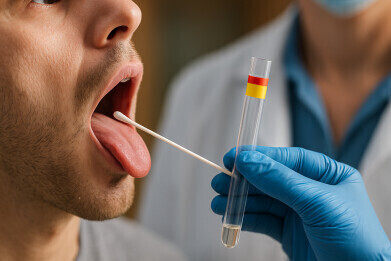
Tulane University researchers have reported the development of an enhanced CRISPR-based test for tuberculosis (TB) that can detect the infection from a simple mouth swab. The test could transform diagnosis of the world’s deadliest infectious disease by enabling wider community-based screening programmes.
Current methods of TB testing depend on sputum which is the mucus collected from the lungs and lower respiratory tract. Although sputum contains the bacteria needed for reliable testing, it is difficult to collect, making it unsuitable for large-scale community diagnosis. In addition, sputum testing is impossible in about 25% of symptomatic cases and in nearly 90% of asymptomatic cases, a gap that contributes to an estimated four million TB cases going undiagnosed worldwide each year.
In the study, the Tulane researchers addressed this problem by refining a previously developed CRISPR-based assay to increase sensitivity to very low levels of bacteria, that can be found in stool samples, spinal fluid and, critically, tongue swabs.
Clinical testing demonstrated markedly improved TB detection from tongue swabs compared with traditional testing, with a detection rate of 74% against 56%. The assay also showed strong sensitivity in other sample types, identifying TB in 93% of respiratory samples, 83% of paediatric stool samples and 93% of adult spinal fluid samples. Because children, patients with human immunodeficiency virus infection and individuals with extrapulmonary TB often cannot produce sputum to be tested, the findings indicate a major advance in the range of viable diagnostic options.
“More than 10 million people worldwide fall ill with TB every year, but 40% of those cases are considered missing as people go undiagnosed,” said corresponding author Dr. Tony Hu, who is the Weatherhead Presidential Chair in Biotechnology Innovation and director of the Tulane Center for Cellular & Molecular Diagnostics.
“To find those missing cases, testing needs to be less invasive and more accessible to reach as many people as possible who may not otherwise be tested,” he said.
Lead author Dr. Zhen Huang, an assistant professor at Tulane University School of Medicine, said developing a viable TB tongue swab test could transform diagnosis in low-resource settings.
“Tongue swabs are painless, easy to collect, and don’t require trained medical staff. That opens the door to large-scale screenings,” Huang said.
The method, called ActCRISPR-TB, enhances amplification and detection of genetic signals from TB bacterial DNA and provides a streamlined approach that can deliver a diagnosis in under an hour. Researchers have devised a ‘one pot’ format that requires neither a laboratory nor specialist personnel. In this version, similar to a COVID-19 lateral flow test, a swab sample is placed into a tube already loaded with reagent and a test strip. After incubation – indeed within 45 minutes – if coloured bands appear on the strip, it indicates the presence of TB infection.
Clinical testing also revealed the assay to be faster and more accurate than conventional methods when applied to sputum nucleic acid, underlining its potential to replace traditional assays even in established diagnostic contexts.
The study formed part of Hu’s wider effort to transfer TB testing out of the laboratory and into the community. His group has already developed portable rapid tests that deliver results in under an hour, including one device the size of a smartphone and another that functions without electricity.
The team has also applied artificial intelligence to predict drug resistance, ensuring that patients receive appropriate therapies more rapidly. Collectively, these innovations set out a practical pathway to combat TB by screening widely, confirming quickly at the point of care and linking positive results to effective treatment.
Although further research and development are needed, Hu and Huang emphasised that the findings represent significant progress.
“If we want to end TB, we need tools that work outside the lab and in the communities where the disease spreads,” concluded Hu.
For further reading please visit: 10.1038/s41467-025-63094-x

Digital Edition
Lab Asia Dec 2025
December 2025
Chromatography Articles- Cutting-edge sample preparation tools help laboratories to stay ahead of the curveMass Spectrometry & Spectroscopy Articles- Unlocking the complexity of metabolomics: Pushi...
View all digital editions









Events
Jan 21 2026 Tokyo, Japan
Jan 28 2026 Tokyo, Japan
Jan 29 2026 New Delhi, India
Feb 07 2026 Boston, MA, USA
Asia Pharma Expo/Asia Lab Expo
Feb 12 2026 Dhaka, Bangladesh




