-
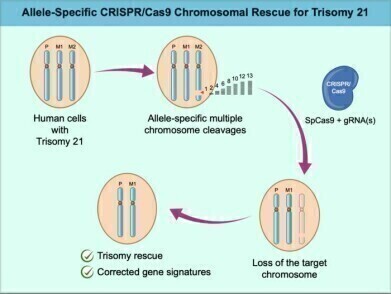 A graphical abstract summarising the CRISPR approach. Credit: Editage
Research news
CRISPR technique used to remove extra chromosomes in trisomy cell line proof-of-concept
Mar 04 2025
Gene editing techniques may eventually allow for trisomy disorders to be treated at the cellular level, according to an in vitro proof-of-concept study. Down syndrome is the most common form of trisomy and is caused by the presence of a third copy of the 21st chromosome.
The condition occurs in approximately 1 in 700 live births and is relatively easy to diagnose at early stages of development. However, there are no treatments.
Ryotaro Hashizume, corresponding author and an assistant professor in the Department of Pathology and Matrix Biology at Mie University Graduate School of Medicine, Mie, Japan, and their colleagues, used the CRISPR-Cas9 gene editing system to cleave the third chromosome in previously generated trisomy 21 cell lines derived from both pluripotent cells and skin fibroblasts.
The technique was able to identify which chromosome had been duplicated, which is necessary to ensure the cell does not end up with two identical copies after removal but instead has one from each parent.
The authors were able to remove duplicate chromosomes from both induced pluripotent stem cells and fibroblasts. Suppressing chromosomal DNA repair ability increased the rate of duplicate chromosome elimination.

Australian team develops novel gene-editing technology with oncology applications
Study advances gene-editing capabilities for cancer and medical research through genetic manipulations using Cas12a enzyme Australian cancer researchers have been the first to establish a no... Read More
The authors also showed that the chromosomal rescue reversibly restores both gene expression and cellular phenotypes. The approach is not yet ready for in vivo application, however, in part because the current technique can also change the retained chromosomes.
According to the authors, similar approaches could eventually be used in neurons and glial cells and form the basis of novel medical interventions for people with Down syndrome.
For further reading please visit: https://doi.org/10.1093/pnasnexus/pgaf022


Digital Edition
Lab Asia Dec 2025
December 2025
Chromatography Articles- Cutting-edge sample preparation tools help laboratories to stay ahead of the curveMass Spectrometry & Spectroscopy Articles- Unlocking the complexity of metabolomics: Pushi...
View all digital editions









Events
Jan 21 2026 Tokyo, Japan
Jan 28 2026 Tokyo, Japan
Jan 29 2026 New Delhi, India
Feb 07 2026 Boston, MA, USA
Asia Pharma Expo/Asia Lab Expo
Feb 12 2026 Dhaka, Bangladesh




