Solutions in Science 2025
SinS 2025: Testing for adulteration across varied cooking oils with 2D mass spectrometry
Jul 18 2025
“Two-dimensional mass spectrometry provides a fully untargeted yet precise method for the identification of key components that can differentiate oils by botanical origin and detect adulteration,” said Anna Cordiner, a doctoral candidate at the University of York, during her presentation at the Solutions in Science 2025 conference in Brighton, United Kingdom.
Cordiner described how her work addresses the rising problem of food fraud in edible oils, which often involves the deliberate mislabelling or dilution of high-value products – such as extra virgin olive oil, with cheaper alternatives. Her research has focused on two-dimensional mass spectrometry (2DMS) as a way to overcome the limitations of traditional targeted methods and to deliver a more comprehensive analytical picture of complex food mixtures.
Cordiner began by outlining the economic scale and diversity of the edible oil market. With oils derived from botanical sources such as olive, avocado, sunflower, rapeseed, walnut, sesame, rice bran and mustard, the sector represents a multibillion-dollar global industry. High-value products – such as extra virgin olive oil – are frequent targets for adulteration, often involving subtle chemical changes that are difficult to detect using conventional techniques.
Traditional methods to determine oil authenticity tend to focus on triacylglycerols, which comprise more than 95 percent of edible oils by mass. These workflows usually rely on targeted detection of known compounds, often following hydrolysis or liquid chromatography separation. While effective in some cases, they may miss less abundant or structurally similar compounds and can be time-consuming and labour-intensive.
Cordiner examined two-dimensional mass spectrometry as a potential solution. Unlike tandem mass spectrometry, which isolates and fragments individual precursor ions in a stepwise fashion, 2DMS fragments all ions simultaneously and correlates each fragment with its precursor by analysing modulation patterns in signal intensity across scans. This method eliminates the need to pre-select analytes and enhances the possibility for detection sensitivity of minor constituents.
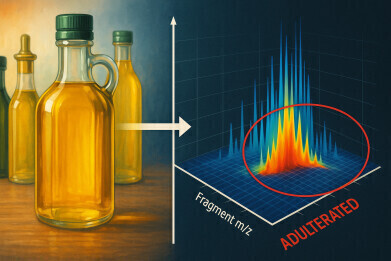
She applied the technique using a Fourier transform ion cyclotron resonance mass spectrometer, which offers ultrahigh mass resolution and is well suited to the analysis of complex mixtures. In the system, ions are modulated through the beam of an infrared laser, and their response across scans is used to correlate precursor and fragment ions. This information is then mapped onto a three-dimensional correlation plot, with precursor ion mass-to-charge ratio (m/z) on one axis, fragment m/z on another, and signal intensity on the third.
Cordiner analysed 13 commercially available edible oils spanning a range of botanical origins. Mass spectrometric data in the triacylglycerol region revealed characteristic patterns for each oil. For example, walnut oil, rich in polyunsaturated fatty acids, produced a distinct profile compared with olive oil. She used these compositional differences to establish a chemical basis for identifying the botanical origin of oils.
To process and annotate the complex 2DMS datasets, Cordiner employed a software platform developed during her doctoral work, named P.I.N.K. This tool enabled the automatic matching of fragmentation spectra to a reference database and allowed for comparison between the ratio of specific triacylglycerols across samples.
Cordiner then applied principal component analysis (PCA) to explore relationships among the oils based on their chemical profiles. The PCA plots revealed clear clustering of oils by type, such as olive, seed and walnut. Oils with partially overlapping composition, such as avocado and grapeseed oil, occupied intermediate positions, reflecting their chemical similarities.
To assess the technique’s potential to detect adulteration, she created synthetic blends of known composition, such as olive oil mixed with sunflower oil in varying proportions. Analysis using the 2DMS methodology showed that as the proportion of adulterant increased, the sample’s PCA position diverged from that of the pure olive oil. Even moderate adulteration of 10 percent was sufficient to shift the sample beyond the cluster of pure oils, although blends containing only 5 percent adulterant remained difficult to distinguish.
She compared these results with commercial oil blends of unknown composition. One such product estimated to contain 85 percent sunflower oil showed a PCA profile closely matching that of a laboratory-prepared blend of the same composition, confirming the method’s applicability to real-world samples.
Cordiner concluded by highlighting the broader relevance of two-dimensional mass spectrometry for complex mixture analysis. The method offers untargeted, high-resolution detection of a wide range of molecules without requiring prior isolation or chemical derivatisation. It also produces detailed datasets that can be reanalysed for future investigations.
She noted that potential applications extend beyond food authenticity, including metabolomics, environmental forensics and pharmaceutical analysis. The ability to retrospectively analyse data for unexpected or unknown compounds could support the identification of non-compliant formulations or previously unrecognised biomarkers.




Digital Edition
Lab Asia Dec 2025
December 2025
Chromatography Articles- Cutting-edge sample preparation tools help laboratories to stay ahead of the curveMass Spectrometry & Spectroscopy Articles- Unlocking the complexity of metabolomics: Pushi...
View all digital editions










Events
Jan 21 2026 Tokyo, Japan
Jan 28 2026 Tokyo, Japan
Jan 29 2026 New Delhi, India
Feb 07 2026 Boston, MA, USA
Asia Pharma Expo/Asia Lab Expo
Feb 12 2026 Dhaka, Bangladesh




