Solutions in Science 2025
SinS 2025: Policies to promote Net-zero offer associated air quality and health benefits: study
Jul 18 2025
Net-zero policy pathways also have the potential to deliver wide-ranging improvements in air quality, health and social equity, according to research presented at the Solutions in Science 2025 conference in Brighton, UK.
Dr Sean Beevers, who is Reader in Atmospheric Modelling at Imperial College London, and leader of its Air Pollution Modelling team within the Environmental Research Group, presented its Net-zero 2050 modelling study of the environmental, health, and economic impacts of the UK’s proposed decarbonisation strategies.
“Decarbonisation and clean air policy must be seen as interconnected,” said Beevers, emphasising that strategically aligned interventions across transport, housing, public health and environmental policy represent the most effective means of achieving the UK’s climate goals while also benefiting the nation’s health and exposure inequalities to pollution.
Framing his analysis within the objectives of the Paris Agreement, Beevers noted that the legal framework for decarbonisation in the UK is built upon The Climate Change Act 2008 (2050 Target Amendment) Order 2019, which set a statutory target to achieve net-zero greenhouse gas emissions by 2050. He stressed that emission abatement must do most of the work, as the country’s capacity for deployment of carbon capture and storage solutions remains, at best, limited.
Beevers’ team drew upon the ‘Balanced Net Zero Pathway’ and a high-innovation variant developed by the Climate Change Committee – the UK’s independent, statutory body that advises the government on climate policy – to compare these scenarios alongside a business-as-usual policy trajectory. Using a nested air quality model refined to 20-metre resolution in urban areas, the researchers estimated exposure to key pollutants, including nitrogen dioxide (NO₂), fine particulate matter (PM₂.₅), and ozone, across different emission sectors.
The modelling forecast that:
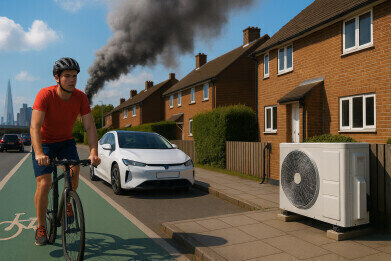
- Decarbonising transport through vehicle electrification would substantially reduce NO₂ emissions by 2050. Reductions in PM₂.₅, however, may prove to more modest due to continued non-exhaust sources for particulates such as brake dust and tyre wear.
- Electrification of homes via heat pump installation will likely reduce PM₂.₅ emissions from domestic heating, particularly in urban areas where other sources will have declined.
- Cycling and other forms of so-called ‘active transportation’, if adopted at scale, would contribute to significant public health gains. Current uptake levels remain low, however, when compared with other interventions.
- NO₂ pollution will remain highly localised and has been closely linked to areas of deprivation, with the most socio-economically deprived groups still set to face the highest levels of exposure.
- Net-zero policies help will narrow inequality to pollution exposure, although disparities will persist, particularly in some regions such as parts of urban Scotland.
- Modelling of PM₂.₅ was found to be more evenly distributed geographically and shows less direct correlation with deprivation that had been expected.
Health impact modelling over a simulated 105-year lifespan – a methodology especially used by UK institutions such its Office for Budget Responsibility and the Department of Health and Social Care – indicated that millions of premature deaths and hundreds of thousands of cases of respiratory and cardiovascular disease could be prevented by implementing net-zero policies. It is an approach which allows planners to anticipate long-term financial pressures on health and care systems, especially in light of the UK’s population ageing.
Beevers highlighted that the inclusion of morbidity outcomes has become increasingly important, reflecting growing evidence of the chronic health burden linked to pollution exposure.
Cost-benefit analyses, following the UK government’s evaluation guidance showed:
- Electrification of transportation is already a cost-effective policy when considering fuel savings, reduced maintenance and avoided health costs.
- Decarbonising building stock (homes) presents greater short-term costs, with payback periods likely to extend into the 2050s.
- However, once health benefits from improved indoor and outdoor air quality are included, the economic case for building interventions becomes significantly stronger.
Beevers also drew attention to indoor air quality as a major policy blind spot. People in the UK spend around 90% of their time indoors but cost-benefit frameworks do not yet account for health improvements from reduced indoor exposures. Modelling from the WellHome study showed that removing indoor sources of pollutants, such as gas cookers can dramatically reduce indoor NO₂ peaks. Beevers called for urgent expansion of high-quality research on indoor pollution exposure levels to strengthen future assessments.
In his closing remarks, Dr Beevers summarised the strategic importance of treating air pollution control and climate policy as a single, integrated agenda. He noted that interventions such as active travel, building electrification and vehicle decarbonisation offer not only environmental and public health returns but also an opportunity to address deep-rooted social inequalities through evidence-led policymaking.




Digital Edition
Lab Asia Dec 2025
December 2025
Chromatography Articles- Cutting-edge sample preparation tools help laboratories to stay ahead of the curveMass Spectrometry & Spectroscopy Articles- Unlocking the complexity of metabolomics: Pushi...
View all digital editions










Events
Jan 21 2026 Tokyo, Japan
Jan 28 2026 Tokyo, Japan
Jan 29 2026 New Delhi, India
Feb 07 2026 Boston, MA, USA
Asia Pharma Expo/Asia Lab Expo
Feb 12 2026 Dhaka, Bangladesh




