Solutions in Science 2025
SinS 2025: Warwick's FTICR 15 Tesla mass spectrometer pushes frontiers of complex mixture analysis
Jul 18 2025
Associate Professor Mark Barrow of the Department of Chemistry at the University of Warwick presented an engaging account of his group’s research into ultrahigh-resolution mass spectrometry at the Solutions in Science 2025 conference, held in Brighton, UK. His talk focused on the use of Fourier transform ion cyclotron resonance (FTICR) mass spectrometry to improve the characterisation of chemically complex mixtures, from petroleum products and bio-oils to environmental and even archaeological materials.
Barrow detailed how the Warwick-based FTICR offered exceptional mass accuracy and resolution, enabling researchers to resolve overlapping signals and assign molecular formulae to thousands of compounds in a single sample. However, he noted that the technique cannot provide full structural information on its own and emphasised the importance of coupling FTICR with other approaches, such as chromatography, tandem mass spectrometry and ion mobility spectrometry, to move closer to a full structural understanding of complex mixtures.
“The identification of molecular formulae is just one step towards the ultimate goal of structural elucidation,” said Barrow, who highlighted the challenges posed by highly heterogeneous samples. Analytical workflows, he explained, must be optimised from sampling to ionisation and detection to prevent bias and capture representative chemical profiles.
Barrow also noted that while electrospray ionisation is often used for its versatility, the choice of ionisation technique must be tailored to the polarity and chemical properties of the analytes. Similarly, instrument selection is critical. Quadrupole and time-of-flight analysers may be sufficient for routine analysis but lack the resolving power to distinguish the many isobaric and co-eluting species commonly encountered in environmental and industrial samples.
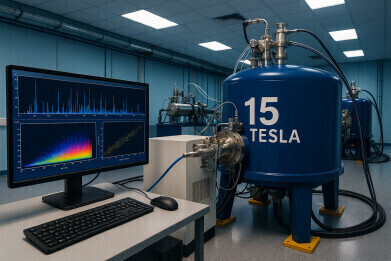
FTICR instruments, particularly those operating at high magnetic fields, have enabled researchers to assign many thousands of molecular formulae in complex mixtures. Warwick University has maintained a 12 Tesla FTICR system for many years and has recently installed a 15 Tesla instrument alongside a Trapped Ion Mobility Spectrometry (TIMS) platform. These systems form part of a research technology platform that is open to academic and industrial collaborators across the UK.
Barrow outlined how his group has used these capabilities to advance levels of petroleum analysis. Crude oil spectra, he said, are densely populated, often with repeating patterns that can aid interpretation.
His group organises FTICR data by heteroatom class, carbon number and double bond equivalents (DBE) to construct molecular fingerprints using bar charts and scatter plots. A plot of DBE against carbon number, for instance, can reveal homologous series and trends in aromaticity.
Barrow traced the development of FTICR’s analytical power from early work in 2001, which reported 3,000 particular molecular species in a crude oil sample, to recent results from his own group, which yielded 244,000 molecular formulae in a heavy distillation fraction from a sample of crude oil from South America.
He acknowledged, however, that these formulae represent only part of the story, as each may correspond to dozens of structural isomers. To address this, his group has explored hyphenated techniques such as gas chromatography–FTICR, initially using time-sliced data extraction to assign compositions across a chromatogram. Recognising the inefficiencies of this method, Barrow collaborated with statisticians to develop an algorithm to extract ion chromatograms directly from the full dataset, improving visualisation and revealing isomeric diversity.
He has also investigated bio-oil samples derived from biomass pyrolysis. Although less complex than petroleum, these too present analytical difficulties. By comparing samples before and after upgrading, his group has been able to track chemical transformations and infer precursor–product relationships.
A recent development in Barrow’s laboratory has involved the integration of TIMS with FTICR. In contrast to traditional ion mobility techniques, TIMS reverses the direction of gas flow and uses a potential gradient to drive separation. He likened the process to wind pushing a sailboat: larger or more extended ions behave like bigger sails and move more quickly. This setup enables orthogonal separation based on ion shape and size, producing a data type he called a ‘mobilogram’, analogous to a chromatogram but based on ion mobility.
His team has used TIMS–FTICR to investigate isomer separation in the gas phase, a long-standing goal in analytical chemistry. At particular DBE values, they observed signal splitting that suggests the resolution of distinct structural isomers.
Barrow concluded by emphasising the broader significance of these developments. The methodologies applied to petroleum chemistry are also relevant in metabolomics, environmental science and archaeology. He reiterated the need to develop robust computational workflows to match the capabilities of modern instrumentation, noting that without effective data interpretation, even the most advanced hardware will fall short of its potential.
He invited researchers from across disciplines to make use of Warwick’s mass spectrometry facilities, noting that wider collaboration will be essential to realise the full value of ultrahigh-resolution mass spectrometry in the UK.

Digital Edition
Lab Asia Dec 2025
December 2025
Chromatography Articles- Cutting-edge sample preparation tools help laboratories to stay ahead of the curveMass Spectrometry & Spectroscopy Articles- Unlocking the complexity of metabolomics: Pushi...
View all digital editions









Events
Jan 21 2026 Tokyo, Japan
Jan 28 2026 Tokyo, Japan
Jan 29 2026 New Delhi, India
Feb 07 2026 Boston, MA, USA
Asia Pharma Expo/Asia Lab Expo
Feb 12 2026 Dhaka, Bangladesh




