News
Ig Nobel prizes 2025: winners, weird ideas and why everything in science matters
Oct 07 2025
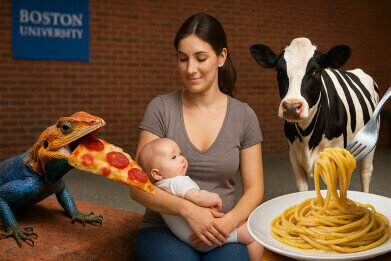
The 2025 Ig Nobel Prizes, presented at Boston University, have honoured ten delightfully odd studies – from pizza-loving lizards and garlic-flavoured breast milk to zebra-striped cattle and the physics of the perfect pasta-sauce – celebrating research that has made us laugh and then think
Boston University has hosted the 35th First Annual Ig Nobel Prize ceremony, a gala of science, satire and spectacle. Genuine Nobel laureates handed awards to researchers whose work ‘first makes people laugh, then makes them think’. The event included its trademark elements: paper aeroplanes flying across the stage, ultra-short acceptance speeches – 60 seconds or less – and a mini-opera this year themed on digestion. Recipients spanned ten fields: from literature to physics, each project curious, whimsical and often grounded in genuine scientific insight.
Literature: a fingertip’s narrative
The Ig Nobel Prize in Literature went posthumously to William B. Bean (USA), in recognition of his long-term measurement of a single fingernail over 35 years. Bean began publishing his nail growth data in 1953 and continued intermittently through the decades – in 1962, 1974, and 1980, among others – the cumulative record provides a rare biographical time series of keratin growth under real-life conditions. While a single nail in one person cannot furnish broad generalisations, the experiment embodies a virtue too seldom praised in modern science: patience, discipline and longitudinal observation. It reminds us that inquiry need not be grandiose to be rigorous. Indeed, Bean’s ‘literature’ lies not in the quality of his prose but in the quiet archiving of data.
This award invites reflection on the tensions between ‘big data’ and the slow, meticulous work of one individual’s measurement. In Bean’s tradition, small cohorts could do similar long-duration measurements. More nails, hair, teeth, a gut microbiome, etc. Such data may reveal subtle secular or environmental trends. So, in an era of high throughput and short snapshots, Bean’s decades of continuity feel radical. In granting this prize, the Ig Nobel committee affirms that scientific legacy sometimes accrues not in renown but in unwavering observation. Bean’s fingernail is emblematic of persistence and curiosity.
Psychology: praise, ego and feedback
The 2025 Ig Nobel in Psychology was jointly awarded to Marcin Zajenkowski (Poland) and Gilles Gignac (Australia/Canada) for investigating what happens when people – whether narcissists or not – are told that they are intelligent. In their experiment, participants received feedback (often deceptive; is there any other in psychology’s experimental designs?) suggesting high intelligence. The researchers then measured transient increases in state narcissism across feelings of uniqueness, entitlement or grandiosity. They found that even in non-clinical populations, flattering feedback could temporarily inflate ego, shifting self-perception. The result underlines how impressionable identity may become under social manipulation.
This work sits at the intersection of personality psychology, social influence and educational feedback theory. In practical contexts – schools, workplaces, therapy – praise is often used to motivate. But this experiment cautions that praise may have unintended side-effects: overconfidence, defensiveness or arrogance. One might ask: how durable is the effect? Does repeated praise blunt returns or provoke backlash? Does cultural context modulate the effect? Or could balanced feedback be achieved to support growth without ego inflation? By delighting the imagination with the simple phrase ‘you are intelligent,’ the experiment reveals how small linguistic nudges can shift identity. The humour is playful; the thinking is sobering.
Nutrition: pizza preferences in lizards
The Ig Nobel Prize in Nutrition went to Daniele Dendi, Gabriel H. Segniagbeto, Luca Luiselli and Roger Meek (a collaboration between researchers in Nigeria, Togo, Italy and France) for studying the pizza choices of rainbow lizards at a seaside resort in Togo. The team offered different pizza variants – plain, single-cheese or multi-cheese – and observed a strong lizard preference for a ‘four-cheese’ pizza.
At first regard it is absurd: reptiles eating pizza? But the experiment probes how animals respond to human food waste in anthropogenic environments. It raises questions about cross-taxon preferences: do lipid + protein combinations attract non-mammalian feeders? Is there an ecological adaptation to novel food stimuli? Could such behaviours influence dietary exposure, microbiomes or even health in exposed wildlife?
In effect, the pizza-eating lizard becomes a lens on opportunistic foraging, food novelty, and anthropogenic ecosystem perturbation. The humour is strong; the thinking resides in whether human food spills alter wild diet behaviour more broadly.
Paediatrics: garlic in milk, baby response
In Paediatrics, Julie Mennella and Gary Beauchamp (USA) were awarded their prize for demonstrating that when a nursing mother consumes garlic, it alters breast milk and correspondingly influences infant suckling behaviour. Their work shows that maternal diet transmits flavour signals to the infant – who tends to suckle longer when milk carries garlic notes.
This research occupies a subtle but rich niche: early flavour exposure, mother–infant chemical signalling and developmental sensory plasticity. In infants, the flavour environment of breast milk may serve as a safe introduction to varied diets, shaping later preferences or acceptance of solid foods. The measurement requires careful timing, quantification of volatile compounds, control of hunger state and feeding protocol.
The broader implication: maternal diet is not just nutritive but communicative. The garlic milk experiment invites expansion: how do other dietary compounds, for example onion, spices or other vegetables influence infant behaviour? Could early flavour exposure ease transitions to solids or reduce feeding aversions?
Peace: a shot of linguistic courage
The Peace Ig Nobel went to Fritz Renner, Inge Kersbergen, Matt Field and Jessica Werthmann – a UK, German and Netherlands team – for demonstrating that drinking a small amount of alcohol can, under certain conditions, improve foreign language speaking ability. In controlled trials, participants who ingested a modest dose of vodka spoke more fluently and confidently in a non-native language when judged by native speakers.
The proposed mechanism is disinhibition: a small dose of alcohol may suppress anxiety, overthinking or self-monitoring, allowing smoother speech production – if the dose does not impair actual articulation. The effect is subtle, context-sensitive and not carte blanche for inebriation.
From a psycholinguistic standpoint, the work highlights how affect and inhibition modulate performance. The humour lies in toasting foreign conversation; the thinking asks how far transient perturbations can enhance communication.
Aviation: the inebriated bat
In Aviation, the Israel-based team of Francisco Sánchez, Mariana Melcón, Carmi Korine and Berry Pinshow earned the prize for measuring how alcohol ingestion impairs flight in bats and their ability to accurately echolocate. In experiments with fruit bats, even moderate doses of ethanol slowed flight, reduced manoeuvrability and degraded echolocation signal quality.
Though amusing, the work probes how finely tuned sensorimotor systems fail under chemical perturbation. Flight and echolocation demand precise timing, spatial coordination and neural synchrony. Alcohol introduces noise, delays or miscalibration into motor and sensory circuits. The broader question: how robust is mammalian navigation under chemical stress? Could analogous studies inform human impairment models? Could wild bats ever ingest fermented fruit and suffer navigational risk?
This prize reminds us that performance and perception vulnerabilities are not exclusively human. The ‘drunk bat’ conjures laughter – but the scientific punch lies in revealing fragile systems under stress.
Biology: stripes that save cattle
The Biology Ig Nobel was awarded to a Japanese team led by Tomoki Kojima, Kazato Oishi and others for painting cows with zebra-like stripes and showing that such patterning reduces fly bites. Experimental cows painted with black and white stripes attracted fewer biting flies than controls.
The experiment draws on biomimicry: zebras are thought to evade flies via stripe interference in visual targeting cues. The researchers translated that hypothesis into applied agriculture. Mechanistically, stripes may distort contrast, motion cues or polarization signals used by flies in landing.
From a practical perspective, many questions remain: durability – paint wear, fading, cost and labour, animal welfare, species specificity (not all flies may be deterred) and scaling to large herds. But could permanent striping via harmless dyes or hair patterns replicate the effect?
The humour is vivid: cows masquerading as zebras. The thinking lies in merging ecological insight with applied vector control. The award reminds us that sometimes nature’s patterns carry practical strategies.
Chemistry: eating Teflon for satiety
In Chemistry, Rotem Naftalovich, Daniel Naftalovich and Frank Greenway won for investigating whether ingesting polytetrafluoroethylene, such as PTFE or Teflon, might increase food bulk without caloric cost, thereby promoting satiety. They formulated test foods – chocolate bars incorporating Teflon – exploring whether the inert filler would expand gastric volume and suppress hunger.
The idea is provocative and contentious: PTFE is (thought to be) chemically inert but not designed for ingestion and safety remains a major concern. From a materials chemistry standpoint, the challenges are extreme: particle size, dispersion, aggregation, inertness under digestion, safety, passage through the gut and interaction with mucosa or microbiota.
The merit of this project lies less in readiness for application and more as a thought experiment. It pushes boundaries of bulk, satiety and filler cognition. It challenges us: can we imagine safe inert bulking agents for appetite control? Might digestible analogues (e.g. hydrogels, fibres) occupy the niche more plausibly?
Here the laughter stems from the absurdity of eating plastic perhaps motivated by the fact that we ingest so much of it passively; the thinking arises from confronting the limits of material science in nutrition.
Engineering design: the contrarian shoe rack
The 2025 Engineering Design Ig Nobel went to Vikash Kumar and Sarthak Mittal (India), who examined how smelly shoes degrade user experience and devised a shoe rack with a UV lamp intended to kill odour-causing bacteria. In trials, the system occasionally damaged shoes due to heating or UV overexposure.
This project underscores how everyday nuisances – foul odour from footwear – pose design challenges. The authors analysed user expectations, smell anticipation and interaction friction. Their prototype blended disinfection and ergonomics; the issues it encountered – safety vs efficacy – mirror those in many ‘smart consumer’ devices.
The humour is rich – the image of a shoe rack that ‘burns’ its trainers – but so is the lesson: engineering design should attend not only to grandeur but small irritations. Every everyday object can become a site for creative improvement.
Physics: the pasta sauce that rebelled
Finally, the Physics Ig Nobel was awarded to a Spanish, Italian, German and Austrian team, Giacomo Bartolucci, Daniel Maria Busiello, Matteo Ciarchi, Alberto Corticelli, Ivan Di Terlizzi, Fabrizio Olmeda, Davide Revignas and Vincenzo Maria Schimmenti, for dissecting the physics behind ‘cacio e pepe’ sauce clumping. The team identified that when the ratio of starch, cheese and liquid crosses a threshold, the sauce transitions abruptly from smooth to clumped – a phase change. They derived critical compositions – around 5 g of starch per 200 g cheese – to avoid such undesirable coagulation.
This work treats cooking as a complex soft-matter problem: colloid interactions, gelation, rheology, kinetic arrest and non-linear instabilities. It reimagines kitchen dramas as the physics experiment.
Beyond the amusement of awarding a prize for pasta sauce, the deeper message is that everyday materials (food emulsions, sauces, dressings) live under the same physical laws as other polymers and gels. Knowing the boundary conditions helps practitioners, chefs and food technologists improve texture, consistency and stability.
The laughter lies in the sheer domestic familiarity of epic sauce fails but the thinking lies in the rigorous deployment of physics to make sure these mishaps never happen again.


Digital Edition
Lab Asia Dec 2025
December 2025
Chromatography Articles- Cutting-edge sample preparation tools help laboratories to stay ahead of the curveMass Spectrometry & Spectroscopy Articles- Unlocking the complexity of metabolomics: Pushi...
View all digital editions









Events
Jan 21 2026 Tokyo, Japan
Jan 28 2026 Tokyo, Japan
Jan 29 2026 New Delhi, India
Feb 07 2026 Boston, MA, USA
Asia Pharma Expo/Asia Lab Expo
Feb 12 2026 Dhaka, Bangladesh




