-
-
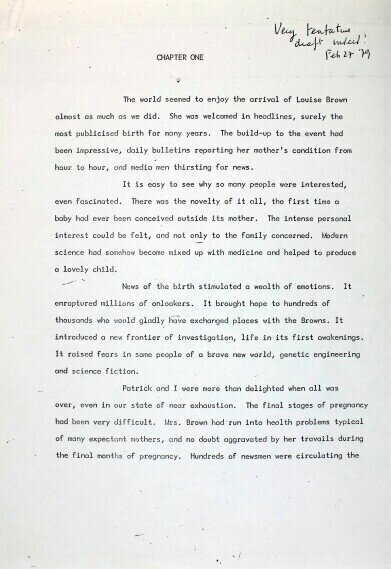 Robert Edwards’s “Very tentative draft indeed” of the opening of Chapter One, which focused on the publicity. Dannie Abse Papers, folder 277, “Chapter One”, 1. The National Library of Wales Collection.
 -
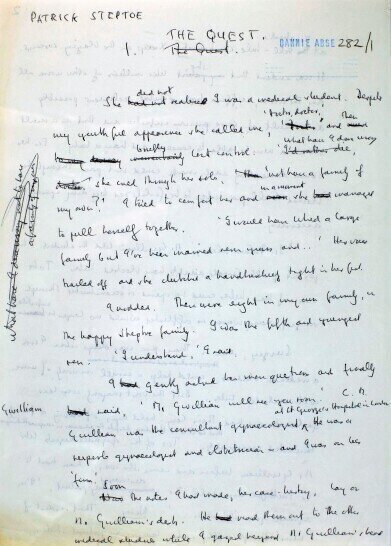 A draft by Dannie Abse of the definitive first chapter, “The Quest”, which begins with a scene of Patrick Steptoe as a medical student encountering a woman suffering from infertility. Dannie Abse Papers, folder 282/1, 1. The National Library of Wales Collection.
 -
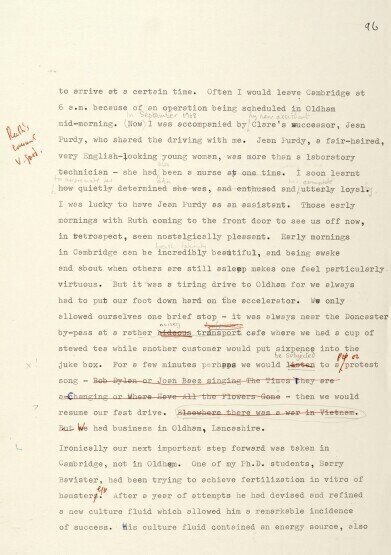 Corrections on Dannie Abse’s manuscript. Robert Edwards’s annotations are in red pen, Ruth Edwards’s in pencil towards the top and Purdy’s in pencil below. Dannie Abse Papers, folder 280, 96. The National Library of Wales Collection.
News
Ghost-writing may have shaped the narrative history of IVF telling the story of the world’s first test-tube baby
Sep 29 2025
Archival research has revealed how poet and physician Dr. Dannie Abse rewrote the autobiography of Dr. Robert Edwards and Dr. Patrick Steptoe – the British pioneers of in vitro fertilisation – behind the birth of Louise Brown, the world’s first test-tube baby. The ghost-writing shaped the public understanding of IVF, to transform a medical breakthrough into a relatable story that helped win acceptance for the controversial project
Previously unseen archival records have revealed how Dr. Dannie Abse – both a poet and medical doctor from Wales – carried out extensive ghost-writing of the autobiography of Dr. Robert Edwards and Dr. Patrick Steptoe, the two British doctors behind the world’s first so-called ‘test-tube baby’. Abse’s input transformed a series of unpolished drafts into a compelling narrative that contributed in the efforts to make in vitro fertilisation (IVF) more acceptable to a sceptical public.
A Matter of Life, co-authored in 1980 by Edwards, a Cambridge-based geneticist who later won the Nobel Prize, and gynaecologist Steptoe, recounted their research that led to their ground-breaking success in IVF. The book, which inspired last year’s Netflix film Joy, has long been regarded as the definitive account of the birth of Louise Brown in 1978. However, new research shows that its voice and structure owed much to Abse’s work on the manuscript rather than only the scientists whose names appeared on the book’s cover.
A study of Abse’s archive at the National Library of Wales by Professor Nick Hopwood of the University of Cambridge has revealed how the poet overhauled the material submitted to Hutchinson, the publisher that had bought the rights to the ‘baby of the century’ story.
Abse, practising physician as well as a prolific poet and biographer in this own right, recast the narrative with heightened emotional intensity, inserting scenes of couples unable to conceive and expanded reports of the role played by the women involved in the project such as Jean Purdy, the nurse from Cambridge who came to assist Edwards’s efforts.
Abse even altered chronology and motivation. According to Hopwood, he recast Edwards’s agricultural studies as a period of fascination with reproduction, describing him as a wartime evacuee marvelling at farm births in ‘the natural laboratory behind hedges… and barn doors’. Such embellishments suggested that both scientists had pursued IVF as a lifelong quest, even though Edwards’s early research had focused on contraception rather than conception.
“Abse improved and enriched the story in many ways. Some changes are problematic as history but without his work very few people would have read the book, which might not even have been published,” said Hopwood, who is based in Cambridge’s Department of History and Philosophy of Science and co-chairs Cambridge Reproduction.
“Abse helped promote IVF at a time when the technique was very controversial.
In search of Jean Purdy: unsung woman and pioneer of IVF who begins to gain recognition, thanks in part to a Netflix feature film
The British embryologist’s work has been consistently overlooked in our male-dominated scientific ecosystem – but her story is beginning to be told.Jean Purdy (1945–1985) is a central, yet st... Read More
“It’s rare to have such rich records of a collaboration on an autobiography and they give extraordinary access to the shaping of a breakthrough story by commercial pressures.
“The process illustrates how, through autobiography, ghostwriters craft what we know about not just politics, sport and the royal family but science and medicine, too,” he added.
Publisher records show that Hutchinson offered an advance of £60,000 – about £400,000 in today’s terms – to Edwards and Steptoe just eight days after Louise Brown’s birth, in order to capitalise on worldwide media coverage. The book appeared twenty months later, before even the main scientific papers were published. Abse received a share of royalties in return for his work, although he has been barely acknowledged in the finished product.
Letters reveal how Harold Harris, a senior editor at Hutchinson, had to persuade Edwards to allow Abse to rewrite their drafts. He promised that “your actual earnings in cash will be considerably greater with Dannie Abse’s assistance than without it”, even though the scientists would have to give up a portion of their royalties. Harris also demanded a longer manuscript – an additional 30,000 words – and urged a more ‘relaxed’ style.
Abse’s influence pervades the book. He doubled the number of chapters, restructured scenes and introduced dialogue that dramatised the struggles of women experiencing infertility. He drew on references from Aldous Huxley and the Bible, and inserted literary devices to foreshadow IVF, including allusions to Sarah, Abraham’s wife, who bore a child in old age. Edwards sometimes objected to these embellishments, writing “Not true” and “This isn’t me!” in the margins but the publishers usually overruled him.
The portrayal of the role of women to the story being told was particularly shaped by Abse.
In particular, Purdy who was a former nurse, emerged as a vivid character through depictions of her long car journeys alongside Edwards from Cambridge to Oldham where Steptoe’s clinic was based. Abse added details of these journeys such as stops at a transport café where Edward’s would choose Bob Dylan to play on the jukebox – Purdy’s corrections to the manuscript replaced ‘listen’ with ‘be subjected to’, showing she was no Dylan fan. She became ‘one of the central cast’ through extended descriptions and dialogue with Abse inserting praise for Purdy’s determination, loyalty and support for the patients.
Above all, Abse elevated the part of Lesley Brown, who became the ‘test-tube mother’. Instead of appearing in the book merely as one of several patients, she was introduced through poignant dialogue attributed to Brown such as: ‘I would be a good mother’, and making her experience of loss a central emotional weight to the story.
“Medical autobiographies cast heroic doctors in struggles against feared scourges,” said Hopwood.
“Here the drama, and support for IVF, depended on creating awareness of the distress caused by infertility.
“After a few failed attempts to come up with a strong opening, Abse tabled this right at the start and set out the quest for a baby as the arc of the book,” he explained.
The finished work drew mixed reviews. Some critics accused it of catering to media sensationalism, while others praised the accessibility it gave to a complex science. Feminist scholars later condemned the narrative as the triumph of two men over a woman’s body, and recent scholarship has also questioned the duration of Edwards’s real interest in fertility. Yet the book remains the central source for the history of IVF.
“Dannie Abse haunts the history of IVF, for better and worse – and it is both,” said Hopwood, whose research was funded by the Leverhulme Trust.
“Powerful narratives can help people understand medical innovations. The great challenge is to produce stories that also ring true, including in the ways they represent various contributions. Historians can help.”
For further reading please visit: 10.1017/mdh.2025.10025

Digital Edition
Lab Asia Dec 2025
December 2025
Chromatography Articles- Cutting-edge sample preparation tools help laboratories to stay ahead of the curveMass Spectrometry & Spectroscopy Articles- Unlocking the complexity of metabolomics: Pushi...
View all digital editions









Events
Jan 21 2026 Tokyo, Japan
Jan 28 2026 Tokyo, Japan
Jan 29 2026 New Delhi, India
Feb 07 2026 Boston, MA, USA
Asia Pharma Expo/Asia Lab Expo
Feb 12 2026 Dhaka, Bangladesh




