-
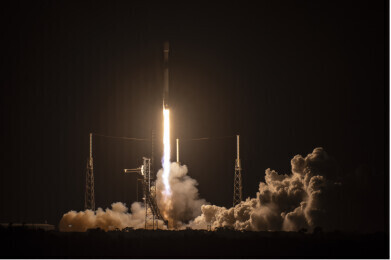 SpaceX Bandwagon-3 mission launch from Cape Canaveral, Florida with ATMOS PHEONIX capsule and Frontier Space payload. Credit: Frontier Space
 -
-for-the-ATMOS-mission-during-the-Flight-model-assembly.jpg) A member of Frontier personnel soldering a Printed Circuit Board (PCB) for the ATMOS mission during the Flight model assembly Credit: Frontier Space
A member of Frontier personnel soldering a Printed Circuit Board (PCB) for the ATMOS mission during the Flight model assembly Credit: Frontier Space -
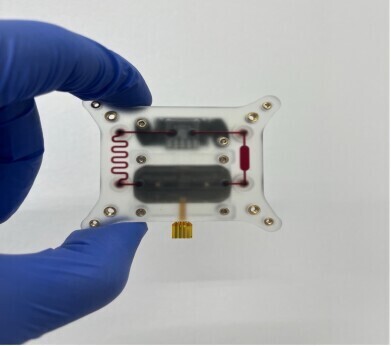 Frontier Space in-house 3D printed microfluidic chip incorporated with microfluidic pump and flow sensor Credit: Frontier Space
News
Frontier Space shares results from first European private life-science mission in orbit aboard ATMOS capsule
Oct 09 2025
Frontier Space has carried out its first orbital mission in partnership with ATMOS Space Cargo, to test the performance of its SpaceLab Mark 1 platform. The kit was launched aboard a SpaceX Bandwagon-3 flight and demonstrated the reliability of core systems for microgravity research
Frontier Space – the UK-based space biotechnology company that spun out from Cranfield University – has completed its inaugural orbital mission in collaboration with ATMOS Space Cargo GmbH, confirming the readiness of its SpaceLab Mark 1 research platform. The flight, launched on 21 April 2025 aboard SpaceX’s Bandwagon-3 and carried within ATMOS’s PHOENIX capsule, demonstrated the viability of key systems that underpin Frontier Space’s project of in-space science and biomanufacturing.
The mission centred on the deployment of SpaceLab Mark 1, a compact and self-contained orbital laboratory designed to support scientific research in microgravity. The first orbital flight had the primary objective to validate essential subsystems, including power supply, computing, imaging and communications. All operated as intended, providing proof of concept for future missions.
“Early orbital data like this accelerates discovery. Each payload we host and each dataset we downlink shortens the path from concept to application,” said Marta Oliveira, chief operating officer of ATMOS Space Cargo.
“For our partners, this means the ability to test and adapt ideas in orbit quickly – an essential advantage for research and commercial teams – building the next generation of products,” she added.
Frontier Space also partnered with Professor Rodrigo Ledesma-Amaro of Imperial College London, who is director of the Bezos Centre for Sustainable Protein and Microbial Food Hub, to test the performance of freeze-dried biological samples in orbit. Although recovery of the samples was not part of the mission design, successful integration and the stability of the samples in Low Earth Orbit were confirmed through on-board monitoring data.
This demonstration has provided an early indication that such material can be reliably carried in private capsules, heralding more accessible biological research in the microgravity environment. Re-entry of biological material has traditionally been restricted by cost, with limited return options, but this mission represents the first attempt by the privately developed European capsule to test the biological payload re-entry capability.
“We have dreamed of a future where humanity sets out into the dark expanses of space. Yet carrying enough food, medicines and materials for that journey would be at unimaginable in cost and weight.
“This mission shows how physics, engineering, biotechnology and space science can converge on that challenge.
“If just a handful of cultivated cells could provide all our food, pharmaceuticals, fuels and bioplastics using freely available resources, we would be one step closer to that future,” said Dr Ledesma-Amaro.
“This mission gave us the confirmation we needed that our baseline systems work in orbit, and it’s also helped highlight where we can improve for next time,” said Aqeel Shamsul, chief executive officer of Frontier Space.
“We are iterating our technology rapidly and already making updates to our systems based on what we saw,” he added.
Future iterations of SpaceLab will expand on these foundations with increased focus on advanced data management, biological sample return and payload scalability. The company is positioning itself as a UK leader in space biotechnology, with ambitions to support pharmaceutical research, biomanufacturing and sustainable food production in orbit. Its modular platform technologies – SpaceLab and Xtreme Space Bioreactor – are intended to create flexible infrastructure for research and development in space.
Digital Edition
Lab Asia Dec 2025
December 2025
Chromatography Articles- Cutting-edge sample preparation tools help laboratories to stay ahead of the curveMass Spectrometry & Spectroscopy Articles- Unlocking the complexity of metabolomics: Pushi...
View all digital editions





Events
Jan 21 2026 Tokyo, Japan
Jan 28 2026 Tokyo, Japan
Jan 29 2026 New Delhi, India
Feb 07 2026 Boston, MA, USA
Asia Pharma Expo/Asia Lab Expo
Feb 12 2026 Dhaka, Bangladesh