
News
Report on UK's PATH-SAFE initiative shows progress in pathogen and AMR monitoring; urges more funding
Sep 30 2025
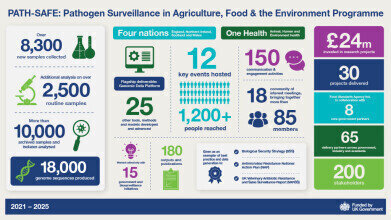
An independent evaluation of PATH-SAFE – the pilot programme for pathogen and antimicrobial resistance surveillance in the UK – has found that it generated valuable data, methods and collaborations across the agri-food and environmental sectors. While some outputs have already shaped decision making, the report concluded that long-term impact will require sustained investment, government coordination, and integration of One Health approaches into routine practice
An evaluation of the pilot programme known as PATH-SAFE – pathogen surveillance in agriculture, food and environment – has concluded that it achieved meaningful outcomes to improve monitoring of food-borne pathogens (FBPs) and antimicrobial resistance (AMR) in the United Kingdom. However, the review has also found that long-term impact will depend on additional investment, policy choice follow-up and integration of its methodology into routine practice.
The programme, which ran with partners across all four nations of the UK, set out to demonstrate how a One Health approach – a framework promoted by the World Health Organization alongside other international bodies – could strengthen pathogen and resistance surveillance across agriculture, food and environmental systems. It aimed to pilot surveillance methods for FBPs and AMR, to bring together and expand existing initiatives, to gather information from end-users and to generate data to understand prevalence, sources and transmission pathways.
The final evaluation focused on the last year of programme funding – March 2024 to March 2025 – taking a theory-based approach, guided by a logic model and outcome measurement framework and drew on a combination of desk research, partner and stakeholder interviews, surveys and case studies.

Diabetes can drive the evolution of antibiotic resistance
Antibiotics are powerful and fast-acting drugs that treat bacterial infections. However, overuse and misuse has caused widespread antimicrobial resistance which continues to evolve and spread.... Read More
RAND Europe had conducted an earlier review of the first phase of PATH-SAFE, which provided a baseline against which to measure progress. Because the final evaluation concluded in March 2025 – before all outputs had been released – it cannot yet account for downstream outcomes and impacts that may emerge later.
The evaluators found that PATH-SAFE had delivered useful data on pathogens and resistance in a range of contexts. This evidence has already informed some decision making, including within the National Biosurveillance Network, and has raised awareness of the importance of the agri-food system in resistance surveillance. The programme also generated knowledge on surveillance methods and tools, some of which have been incorporated into routine operations, and it strengthened collaborative relationships between agencies and institutions.
The report also noted that certain insights have already shaped policy and practice but it emphasised that the programme’s long-term value depends on embedding these tools and relationships into established surveillance structures. The central management team was credited with enabling coordination across projects, creating accountability, consolidating lessons and managing risks. Ring-fenced funding gave partners the capacity to prioritise activities while regular cross-programme events facilitated knowledge exchange and fostered a shared mission among participants.
Yet despite these successes, the evaluation stressed that sustained investment and systemic changes will be required to maximise impact. It recommended that government departments should create a follow-up funding package with clear ownership and accountability. Suggested areas for investment included:
- Continued support for the bulk milk surveillance system which proved valuable in the avian influenza response in 2024
- Expansion of the genomic data platform for Salmonella, Escherichia coli and Listeria that Food Standards Scotland and the UK Health Security Agency have begun to trial
- Further development of wastewater-based surveillance methods that could complement existing polio monitoring systems.
Another recommendation was to establish a cross-government surveillance knowledge repository to consolidate and share PATH-SAFE’s data, methods and operational lessons. This should include sector-specific guides for animal health, food safety, and the environment and a policy roundtable to bring together senior UK officials from the Cabinet Office, the Department of Health and Social Care, the Department for Environment, Food and Rural Affairs and the administrations of the nations of Wales, Scotland and Northern Ireland according to their devolved competencies.
The evaluation also called for a follow-up review in 2027, by which time many of PATH-SAFE’s outputs will have had an opportunity to further influence best practice. Such a review should measure the long-term adoption of methods, assess whether collaborative networks have endured, and determine whether improved surveillance has contributed to faster outbreak detection and response.
The findings highlighted persistent challenges around data sharing. While PATH-SAFE facilitated some progress within the programme, broader structural and legal barriers limited the ability to establish cross-programme agreements. Future initiatives, the report suggested, must tackle issues of inconsistent regulatory interpretation, metadata standards, cross-sector data linkage and anonymisation at national level rather than leaving them to the jurisdictional risk of departmental bilateral negotiations.
In addition, the evaluators argued that project prioritisation should follow transparent criteria which align with departmental and government-wide surveillance strategies. Priorities should reflect the ability of specific methods to inform prevention and mitigation, their cost-effectiveness and their compatibility with existing programmes. This should therefore increase the possibility of investment producing complementary and coordinated outputs.
The evaluation concluded that future surveillance programmes should replicate certain structural elements of PATH-SAFE, such as a strong central management team, pilot-phase funding with continuation criteria, conditional implementation funding and sustainability planning in place from the outset. These features, combined with clear accountability and strategic alignment, would enhance the long-term contribution of the One Health approach to emerging pathogen surveillance in the UK.
The full report can be read at the UK government’s website here:
https://science.food.gov.uk/article/138396-path-safe-final-evaluation-report




Digital Edition
Lab Asia Dec 2025
December 2025
Chromatography Articles- Cutting-edge sample preparation tools help laboratories to stay ahead of the curveMass Spectrometry & Spectroscopy Articles- Unlocking the complexity of metabolomics: Pushi...
View all digital editions










Events
Jan 21 2026 Tokyo, Japan
Jan 28 2026 Tokyo, Japan
Jan 29 2026 New Delhi, India
Feb 07 2026 Boston, MA, USA
Asia Pharma Expo/Asia Lab Expo
Feb 12 2026 Dhaka, Bangladesh




