Microscopy & microtechniques
Vivid Scientific Research at the University of Silesia
Feb 14 2013
Birefringence, a property of a crystalline material describes how within the material there are two distinct indices of refraction. Birefringent materials are used to create polarising filters or interference colours.
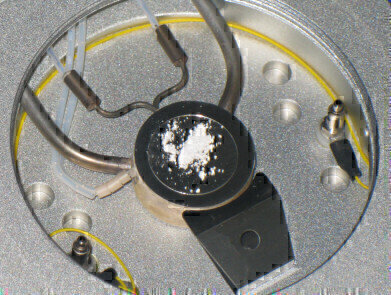
Krystian Roleder, the Regional Editor for the Central and Eastern Europe edition of the multinational journal ‘Phase Transitions’ and Researcher at the Institute of Physics, University of Silesia, Poland, has been studying birefringence measurements for a number of years. Mr Roleder has been using the THMSG600 stage to study birefringence in several materials, including BaTiO3. He commented: “This Linkam stage is indispensable for my scientific work."
In this research, Roleder and his colleagues have focused on the materials properties above crystallisation temperature. BaTiO3 has been the focus of many research projects since its first recognition in the 1940s. Extensive studies have looked at the phase transitions and domain structure along with the optical, electrical and mechanical properties. The cubic to tetragonal phase change is described as the order-disorder type and is displacive in nature. It is widely accepted that the Ti ion becomes displaced from its position within the oxygen octahedron, and this is the cause of the polar region formation within the crystal. It was found that the BaTiO3 crystals were birefringent over a broad temperature range but disappeared over 160-170°C.
The group has demonstrated the temperature dependence of the birefringence above crystallisation temperature and the behaviour of anomalous birefringence can be attributed to the existence of polar clusters. These polar clusters originate due to the interdependence of the structural and polar soft modes. These polar clusters interrupt the cubic symmetry of the crystal and about crystallisation temperature the crystal become birefringent. These polar regions are connected to the movement of the Ti molecule within the oxygen cage.
Samples were tested using the THMSG600 stage on an Oxford Cryosystems Metripol Birefringence Imaging System and heated at a constant 0.2°C/min.
The THMS600 is one of the most widely used heating and freezing microscope stages on the market. With its excellent 0.1°C accuracy and stability, the THMS600 is used in many applications including birefringence research. The stage gives researchers the option to characterise their sample quickly by heating to within a few degrees of the required temperature at a rate of up to 150°C/min with no overshoot.
.jpg)
-(2).jpg)

Digital Edition
Lab Asia Dec 2025
December 2025
Chromatography Articles- Cutting-edge sample preparation tools help laboratories to stay ahead of the curveMass Spectrometry & Spectroscopy Articles- Unlocking the complexity of metabolomics: Pushi...
View all digital editions










Events
Jan 21 2026 Tokyo, Japan
Jan 28 2026 Tokyo, Japan
Jan 29 2026 New Delhi, India
Feb 07 2026 Boston, MA, USA
Asia Pharma Expo/Asia Lab Expo
Feb 12 2026 Dhaka, Bangladesh




