-
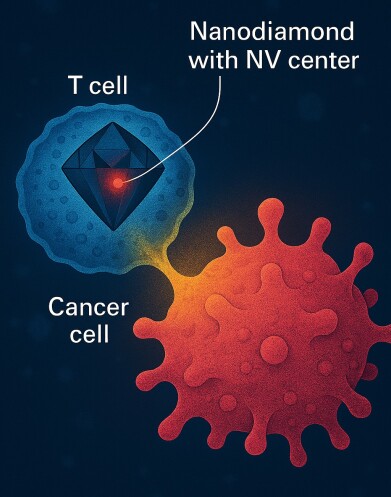 AI-generated image of a T-cell interacting with a cancer cell. Credit: Heriot-Watt University
 -
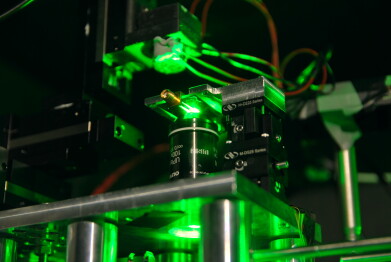 Inside a quantum lab at Heriot-Watt University. Credit: Heriot-Watt University
Research news
Quantum sensors to reveal why immune cells fail against cancer
Dec 15 2025
A Heriot-Watt University researcher has secured £2 million in funding to develop quantum sensors capable of watching immune cells as they battle cancer — offering a rare view into why some treatments work for certain patients but fail in others.
Dr Aldona Mzyk’s project will create sensors small enough to probe signals from a single electron, capturing real-time molecular changes as immune cells enter the hostile environment of a solid tumour. These ultra-sensitive devices will follow the metabolic breakdown that leaves cancer-fighting cells exhausted and ineffective, detecting variations thousands of times smaller than the width of a human hair.
The work targets a major problem in cancer immunotherapy. CAR-T therapies, which can clear blood cancers, struggle in solid tumours because cancer tissue releases metabolites that undermine the engineered immune cells’ metabolism. Dr Mzyk’s quantum platform aims to reveal this failure mechanism as it happens, observing the chemical sabotage inside thousands of cells within seconds.
Now based at DTU in Copenhagen, Dr Mzyk will join Heriot-Watt’s Institute of Photonics and Quantum Sciences to lead the four-year Future Leaders Fellowship, funded by UK Research and Innovation. She said: “Seventeen people die from cancer every minute. To understand why immune cells fail, we need to monitor the free radicals that drive their metabolism — essentially eavesdropping on what happens when they meet cancer. Quantum sensors finally allow us to capture these fast, tiny signals with the precision required.”
The project combines quantum sensing with optical spectroscopy and microfluidics, forming a single platform that could accelerate the development of personalised treatments and provide earlier insight into whether anti-cancer drugs are working. It also aligns with the UK’s National Quantum Technology Programme and ongoing efforts to bring clinical-grade quantum technologies into the NHS.
Professor Cristian Bonato, Principal Investigator for the Nanoscale Quantum Sensing facility at Heriot-Watt, said the fellowship represents “the kind of bold application of quantum technology that could reshape biomedical diagnostics”, noting that the university is involved in multiple national quantum hubs focused on sensing, imaging and healthcare.
More information online



Digital Edition
Lab Asia Dec 2025
December 2025
Chromatography Articles- Cutting-edge sample preparation tools help laboratories to stay ahead of the curveMass Spectrometry & Spectroscopy Articles- Unlocking the complexity of metabolomics: Pushi...
View all digital editions









Events
Jan 21 2026 Tokyo, Japan
Jan 28 2026 Tokyo, Japan
Jan 29 2026 New Delhi, India
Feb 07 2026 Boston, MA, USA
Asia Pharma Expo/Asia Lab Expo
Feb 12 2026 Dhaka, Bangladesh




