-
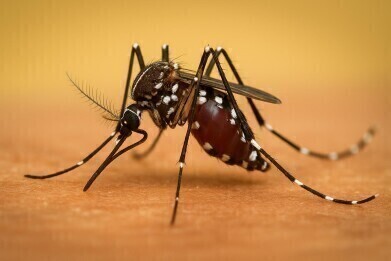 An AI-generated image of the Aedes aegypti mosquito which is the transmission vector for the Zika virus. Credit A.Booth via ChatGPT
Research news
Zika virus uses ‘self-care’ system of host’s cells as protection
May 28 2025
Virus’ strategy to maintain persistent infection discovered in Ohio State study
A study by virologists from the Department of Veterinary Biosciences at the Ohio State University, Columbus, has discovered the fundamental biology behind the Zika virus’ infectiousness. The virus uses its host cells’ own repair and renewal systems that clear away unwanted molecules to suppress certain host proteins.
Cell surface proteins are the key for initial viral entry into cells, but they also contribute to antiviral response. However, the virus changes the processes by which cells maintain their health and lower the proteins’ activity before that can happen to repel the viral attack, so allowing for unchecked infection by Zika.
“Other viruses – such as HIV – can silence host receptors to gain cell penetration, but unusually Zika has at least three proteins of its own that can get the job done,” said Professor Shan-Lu Liu, senior author the study from the Veterinary Biosciences at Ohio State.
“That’s the most interesting part: It’s amazing that not only one, but several Zika proteins can do this,” added Liu, who is also a professor in the Department of Microbial Infection and Immunity.
“We looked at two Zika virus strains and examined three physiologically relevant cell types. With both strains, we could see the downregulation in all three cell types. It looks like this is an important mechanism.”
The Zika virus has caused infectious outbreaks in many regions across Africa, the Americas, Asia and the Pacific since 2007, according to the World Health Organization. It is transmitted to humans primarily by Aedes aegypti mosquito bites.
In Brazil, in 2015, a large epidemic led to the confirmation of a link between infection during pregnancy by Zika and babies born subsequently to have microcephaly – a smaller than normal head size. Although infected people rarely develop symptoms – or experience only mild signs of the disease – the virus has also been linked to Guillain-Barré syndrome (GBS), neuropathy and myelitis – spinal cord inflammation – in adults and older children.
GBS is a rare but serious autoimmune disorder in which the body’s immune system mistakenly attacks its own peripheral nervous system. Guillain-Barré syndrome is a medical emergency and requires prompt treatment to prevent life-threatening complications such as respiratory failure. Most people recover fully, although recovery can take weeks to months. Some individuals may experience lingering weakness, fatigue, or nerve damage.
Since 2017 Zika cases have declined overall, globally, but its transmission continues at persistent low levels in the Americas and across others of the endemic regions.
Previous research has shown that specific cell surface proteins known as PS receptors are important entry points for many viruses, including Zika. The Ohio State study focused on two of these proteins – AXL and TIM-1 – that had previously been linked to Zika infection.
The team completed cell culture experiments using African and Asian strains of Zika virus in three types of cells related to respiratory, reproductive and neurological systems targeted by the pathogen: human cells that line the lungs, embryo-supporting cells called trophoblasts and glioblastoma brain cancer cells.
Experiments showed that both AXL and TIM-1 were downregulated on the three types of cells after infection by Zika. The researchers expected to find this suppression occurred through two common protein degradation processes but found instead that the Zika virus makes use of the cellular repair process of autophagy.
“Autophagy is a fundamental physiological mechanism to conserve cellular processes by degrading host components.
“It’s also called self-eating – the host needs to remove their own damaged organelles or misfolded proteins because they’re not good for the host,” said Liu.
Zika’s viral adaptive infectious process manipulated the host cells into suppressing their own protective proteins. Without this suppression, AXL and TIM-1 would begin producing inflammatory molecules as part of their antiviral response.
Normal levels of AXL and TIM-1 facilitate viral entry and so could also enable more Zika to access already-infected cells creating a ‘superinfection’ – which is something viruses generally want to avoid. Further experiments identified three Zika proteins that prompt host cell autophagy, all being located in the virus’s membrane.
“Normally those proteins mediate viral entry or are involved in viral replication, but they’re also responsible for this downregulation – kind of a new function, which is not so surprising because viruses encode something that’s important for them, either for their own replication or to modulate the host,” Liu said.
Further research is needed but it is possible that this mechanism is also relevant to Ebola, which also uses TIM-1 to access host cells. Other virus pathogens in the same flavivirus family include West Nile fever, yellow fever and dengue.
“The bottom line is this speaks to the co-evolution of viral-host interactions. The more important a host factor is to a virus, the more a virus is going to do to take control of it,” Liu said.
“Understanding these mechanisms is an important part of being prepared for emerging or reemerging viruses that cause infectious diseases,” Liu conclude.
This work was primarily conducted by Jingyou Yu, a former graduate student in the Liu lab and now a principal investigator at the Guangzhou National Laboratory in China. Additional contributions were made by Yi-Min Zheng, a senior scientist, and Pei Li, a postdoctoral fellow in the Liu lab. This work was primarily supported by an Ohio State fund and the National Institutes of Health.
For further reading please visit: 10.1073/pnas.2427241122



Digital Edition
Lab Asia Dec 2025
December 2025
Chromatography Articles- Cutting-edge sample preparation tools help laboratories to stay ahead of the curveMass Spectrometry & Spectroscopy Articles- Unlocking the complexity of metabolomics: Pushi...
View all digital editions







Events
Jan 21 2026 Tokyo, Japan
Jan 28 2026 Tokyo, Japan
Jan 29 2026 New Delhi, India
Feb 07 2026 Boston, MA, USA
Asia Pharma Expo/Asia Lab Expo
Feb 12 2026 Dhaka, Bangladesh