-
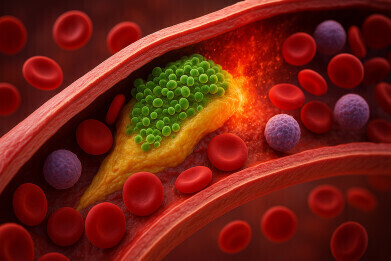 Bacterial involvement in coronary artery disease. Credit: AJGB
 -
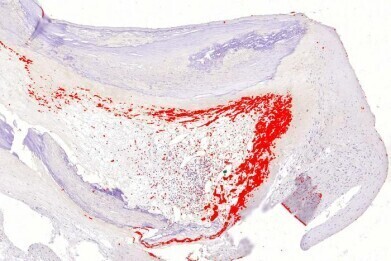 Asymptomatic bacterial biofilm lining a cholesterol-laden coronary artery plaque. Credit: Pekka Karhunen’s research group, Tampere University
Research news
Study suggests heart attacks may be triggered by infectious biofilms
Sep 05 2025
A collaborative study by researchers in Finland and the United Kingdom has demonstrated for the first time that myocardial infarction – heart attack – may have an infectious origin. The discovery challenges the established view of how heart attacks develop and has opened avenues for diagnostics, therapies and vaccine research.
The research has suggested that infection may act as a trigger for myocardial infarction. Analysis of coronary artery disease revealed that atherosclerotic plaques laden with cholesterol can harbour a gelatinous biofilm created by bacteria over many years. These bacteria remain dormant and protected inside the biofilm, hidden both from the immune system and from antibiotics that cannot penetrate the matrix.
A viral infection or other external stress may disturb this balance, activating the biofilm and allowing bacteria to proliferate. The ensuing inflammation can rupture the fibrous cap of the plaque which then leads to clot formation and myocardial infarction.
“Bacterial involvement in coronary artery disease has long been suspected, but direct and convincing evidence has been lacking. Our study demonstrated the presence of genetic material – DNA – from several oral bacteria inside atherosclerotic plaques,” said Professor Pekka Karhunen, who led the study. He added that until now, experts had assumed that coronary artery disease began solely with oxidised low-density lipoprotein which the body identifies as a foreign object.
The team validated its observations by developing an antibody against the identified bacteria, which unexpectedly revealed biofilm structures in arterial tissue. In patients who had suffered myocardial infarction, bacteria released from the biofilm were detected and found to trigger inflammation that ruptured cholesterol-rich plaques.
The findings have opened the prospect of novel diagnostic and therapeutic strategies for coronary artery disease. They have also raised the possibility of vaccination to prevent heart attacks in the future.
The study was carried out by Tampere University, Oulu University, and the Finnish Institute for Health and Welfare – all in Finland – and the University of Oxford, UK. Samples were obtained both from individuals who had died suddenly from cardiac arrest and from patients with atherosclerosis who underwent surgery to clear carotid and peripheral arteries.
The project formed part of a European Union-funded cardiovascular research initiative spanning 11 countries, with further support from the Finnish Foundation for Cardiovascular Research and the Jane and Aatos Erkko Foundation.
For further reading please visit: 10.1161/JAHA.125.041521


Digital Edition
Lab Asia Dec 2025
December 2025
Chromatography Articles- Cutting-edge sample preparation tools help laboratories to stay ahead of the curveMass Spectrometry & Spectroscopy Articles- Unlocking the complexity of metabolomics: Pushi...
View all digital editions






Events
Jan 21 2026 Tokyo, Japan
Jan 28 2026 Tokyo, Japan
Jan 29 2026 New Delhi, India
Feb 07 2026 Boston, MA, USA
Asia Pharma Expo/Asia Lab Expo
Feb 12 2026 Dhaka, Bangladesh