-
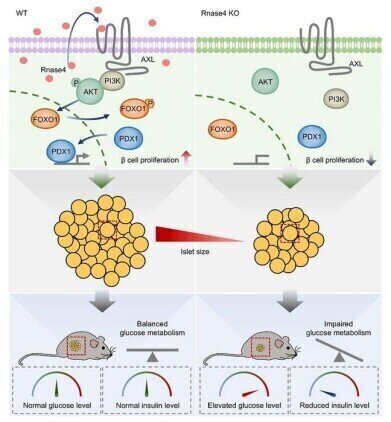 Rnase4 regulates the proliferation of pancreatic islet β cells and blood glucose homeostasis through the Axl-PI3K/Akt/FoxO1/Pdx1 signalling pathway. Credit: ©Science China Press
Research news
Ribonuclease 4 identified as a pancreatic endogenous β cell proliferation factor
Jul 07 2025
A team of researchers led by Professor Zhengping Xu of the Zhejiang University School of Medicine and the affiliated Sir Run Run Shaw Hospital has identified ribonuclease 4 (Rnase4) as a key endogenous regulator of pancreatic islet β cell proliferation. The findings, published in Science Bulletin, suggest that Rnase4 may play a critical role in promoting islet development and maintaining blood glucose homeostasis.
Islet β cells, the body’s principal source of insulin, are central to glucose regulation. Although a range of growth factors and hormones have been shown to encourage β cell proliferation, these typically originate from other organs such as the liver and intestines and respond primarily to glucose or insulin resistance. Until now, no factor produced within the β cells themselves and expressed during pancreatic development had been confirmed to physiologically drive their proliferation.
The research team demonstrated that Rnase4 is highly expressed in pancreatic islets and is specifically enriched in β cells. Its expression in neonatal mice paralleled the postnatal surge in β cell proliferation, indicating a developmental association. Through genetic knockout studies in mice, the scientists found that the absence of Rnase4 in β cells led to reduced proliferation, a lower cell count, and smaller islets.
Mechanistic analysis revealed that Rnase4 binds to the Axl cell surface receptor, activating the PI3K/Akt/FoxO1/Pdx1 signalling pathway, thereby promoting cell proliferation. Mice lacking Rnase4 exhibited reduced insulin levels and impaired glucose regulation. However, supplementation with Rnase4 restored islet function and glucose metabolism, not only in Rnase4-deficient models but also in animals subjected to β cell damage through streptozotocin or caerulein exposure.
These findings highlight the vital role of β cell-derived Rnase4 in maintaining pancreatic function and suggest that targeted delivery of Rnase4 may offer a novel therapeutic strategy for conditions characterised by β cell loss, including diabetes.
Dr Chen Muxiong of Sir Run Run Shaw Hospital and Dr Liu Yaxin of Liangzhu Laboratory, Zhejiang Province, are co-first authors of the study. Professor Zhengping Xu and Dr Bai Rongpan, also of Sir Run Run Shaw Hospital, served as co-corresponding authors. The study was supported by the National Natural Science Foundation of China, the Fundamental Research Funds for the Central Universities, the Leading Innovative and Entrepreneur Team Introduction Programme of Zhejiang, and the Leading Innovation and Entrepreneur Team of Hangzhou.
For further reading please visit: 10.1016/j.scib.2025.04.052




Digital Edition
Lab Asia Dec 2025
December 2025
Chromatography Articles- Cutting-edge sample preparation tools help laboratories to stay ahead of the curveMass Spectrometry & Spectroscopy Articles- Unlocking the complexity of metabolomics: Pushi...
View all digital editions








Events
Jan 21 2026 Tokyo, Japan
Jan 28 2026 Tokyo, Japan
Jan 29 2026 New Delhi, India
Feb 07 2026 Boston, MA, USA
Asia Pharma Expo/Asia Lab Expo
Feb 12 2026 Dhaka, Bangladesh




