-
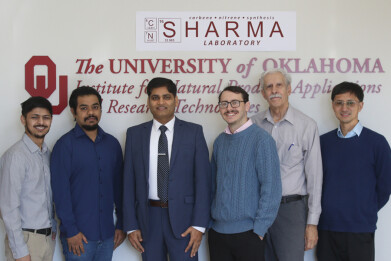 Dr. Sharma (third from left) with his research team at University of Oklahoma. Picture: Josh DeLozier
Research news
Air conditioning: nitrogen method set to enhance drug discovery
Jan 09 2025
University of Oklahoma team unveils novel method of adding a single nitrogen atom to drug molecules
A University of Oklahoma (OU) team has developed a novel method of adding a single nitrogen atom to molecules which could unlock new dimensions in drug development, according to work published in the Science.
OU associate professor Indrajeet Sharma’s team demonstrated that the use of a short-lived chemical called sulfenylnitrene can insert one nitrogen atom into bioactive molecules ─ in a process is called skeletal editing ─ which produces new ‘pharmacophores’ that are useful for making drugs. Nitrogen-containing chemical structures are called heterocycles and are important in drug development and discovery.
The technique builds on the work of Sir Derek Barton who was the recipient of the Nobel Prize in Chemistry in 1969. The UK’s Royal Society for Chemistry awards an international prize in his honour.
“85% of all existing FDA-approved drugs have one or more nitrogen atoms. And, when you look at the top 200 brand name drugs, more than 75% have nitrogen heterocycles,” said Sharma.
“By selectively adding one nitrogen atom to these existing drug heterocycles in the later stages of development, we can change the molecule’s biological and pharmacological properties without changing its functionalities.”
ILM WEBINAR SERIES 2025 – BOOK NOW
he process of the skeletal editing process could allow for greater diversity in drug development. Rather than developing new drugs from scratch, changing a single nitrogen atom in an existing chemical has the potential to open up an entirely new set of drugs.
DNA, RNA, proteins and amino acids are all made with nitrogen. Consequently, Sharma’s team’s research may have far-reaching potential for the treatment of many classes of disease.
Previously published research in this field demonstrated a similar concept but required conventional nitrenes and generated an excessive amount of oxidizing agent, which was not compatible with many drug molecules.
Sharma’s team uses a method for producing sulfenylnitrenes that is additive-free, metal-free and compatible with other functional groups within the molecule.
“The cost of drugs depends on the number of steps involved in making them, and [manufacturers] are interested in finding ways to reduce these steps.
“By adding a nitrogen atom, you can make new drugs more cheaply. It’s like renovating a building rather than building it new from scratch,” he said.
For further reading please visit:

Digital Edition
Lab Asia Dec 2025
December 2025
Chromatography Articles- Cutting-edge sample preparation tools help laboratories to stay ahead of the curveMass Spectrometry & Spectroscopy Articles- Unlocking the complexity of metabolomics: Pushi...
View all digital editions









Events
Jan 21 2026 Tokyo, Japan
Jan 28 2026 Tokyo, Japan
Jan 29 2026 New Delhi, India
Feb 07 2026 Boston, MA, USA
Asia Pharma Expo/Asia Lab Expo
Feb 12 2026 Dhaka, Bangladesh




