-
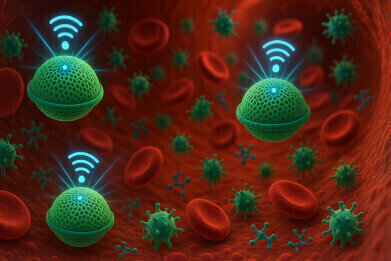 An AI-generated representation of nanoscale sentinel robots in the bloodstream. Credit: A. Booth via ChatGPT
 -
 Credit: Marek Piwnicki, Pexels
Research news
Nanoscale biosensor sentinels could guard against molecular level pathogen threats to health in real time
May 23 2025
After 20 years of development biosensors have been built that are able to measure chemical and biological reactions inside the body and transmit a readable signal to outside instrumentation. Biosensor devices can isolate minute drug molecules in real time but until now their working lifespan has been measured in hours not days or weeks.
A research team from the California-based Stanford University has engineered a modular biosensor system – the Stable Electrochemical Nanostructured Sensor for Blood In situ Tracking (SENSBIT) – which can now function for up to a week. The study involves direct implantation into the blood vessels of live rats and has shown that SENSBIT could continuously track drug concentration profiles.
Over the course of ten years, the Stanford lab has designed a ‘molecular switch’ that binds to small molecules of interest in the body to continuously measure the molecules’ concentrations. The body’s natural immune response is to protect itself against these ‘switches’ and so they are prone to degradation.
In further work, to move forward from this issue, the team ‘hid’ the switches in nanoporous electrodes. These electrodes could then make signals that allowed – for the first time – the measurement of drug levels inside the of tumour a live rat. But despite the advance in the technology the switches still did not last long due to the immune system attacks.
“What we needed [to find was] a material system that could sense the target while protecting the molecular switches. So, I thought, how does biology solve this problem?” said doctoral candidate Yihang Chen, the first author of the paper, who was conducting materials science research.
Inspiration was found in the human gut by Chen and his team who designed the SENSBIT system after natural defences seen in the gut. They built a 3D nanoporous gold surface that shields the sensor’s sensitive elements from interference and act in a similar manner to the intestinal wall’s microvilli when coupled with a protective coating which itself is modelled on gut mucosa to help prevent degradation.
Chen’s team tested SENSBIT and saw it retained almost three-quarters of its signal following a month in undiluted human serum – which is similar to blood plasma but without clotting factors, especially fibrinogen – and more than 60% after a week implanted in the blood vessels of live rats.
Previous upper limits seen for intravenous exposure for this type of device is believed to be no more than 11 hours. Lasting for a week the SENSBIT was able to deliver reliable, real-time molecular monitoring in complex biological fluids.
“This work began more than twelve years ago and we have been steadily advancing this technology,” said the W. M. Keck Foundation Professor Tom Soh, whose work is at the intersection of electrical engineering, bioengineering and radiology in the schools of Engineering and Medicine, and is senior author of the paper.
“This order-of-magnitude improvement over existing technologies – for whole-blood sensor longevity – is a huge step towards next-generation biosensors,” he said.
This bioinspired design allowed SENSBIT to remain stable and sensitive even after many days of continuous exposure to living animals’ blood flow.
Understanding how the body coordinates its response using these molecules, we could potentially pick up infections before any symptoms arise.
The human immune system has a very integrated strategy in the face of an infection by a virus, bacteria or other invading pathogen. Understanding the mechanisms deployed by the body in its coordination against invading molecules could potentially mean infections might be detectable before presentation of symptoms.
From a biomedical perspective being able to use effective continuous molecular monitoring would be a paradigm shift in therapeutics – one in which disease is detected earlier and treatments tailored to put down infections in real time.
“I believe our work contributes to laying the foundation for this future and I’m motivated by the opportunity to help push those boundaries forward,” added Chen.
For further reading please visit: 10.1038/s41551-025-01389-6




Digital Edition
Lab Asia Dec 2025
December 2025
Chromatography Articles- Cutting-edge sample preparation tools help laboratories to stay ahead of the curveMass Spectrometry & Spectroscopy Articles- Unlocking the complexity of metabolomics: Pushi...
View all digital editions










Events
Jan 21 2026 Tokyo, Japan
Jan 28 2026 Tokyo, Japan
Jan 29 2026 New Delhi, India
Feb 07 2026 Boston, MA, USA
Asia Pharma Expo/Asia Lab Expo
Feb 12 2026 Dhaka, Bangladesh




