-
-
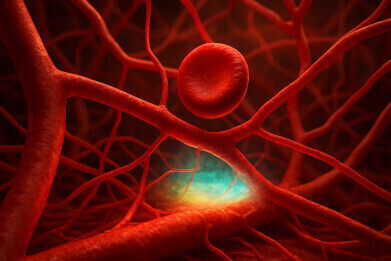
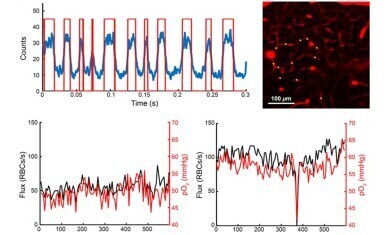 Researchers used a two-photon phosphorescent probe to monitor capillary flux and oxygen in sets of capillaries, obtaining a robust oxygen and flux estimate within each capillary, sufficient to observe spontaneous stalls in flow. They consistently observed a distinct drop in intracapillary oxygen for the duration of the stall, followed by rapid recovery back to normal levels on the resumption of flow. Credit: J. Giblin et al.
Research news
Momentary capillary stalls in the brain trigger dangerous oxygen loss: study
Sep 18 2025
Researchers at Boston University and Massachusetts General Hospital have shown that even brief stalls in tiny brain capillaries can cause sudden drops in oxygen, with levels sometimes falling below the threshold needed to sustain cell energy. The findings reveal how repeated interruptions in microvascular blood flow may contribute to dementia, stroke and other neurological diseases
The brain depends on a constant supply of oxygen delivered through an intricate network of tiny blood vessels. Unlike other organs, it has very little stored energy and is sensitive to interruptions in its blood flow. While blockages in larger vessels are known to have devastating consequences, less is understood about the effects of momentary stalls in capillaries, the smallest vessels. These events have been observed more often in ageing and in conditions such as Alzheimer’s disease, stroke and traumatic brain injury.
A study led by researchers at Boston University and Massachusetts General Hospital has shown that even brief interruptions in capillary flow can cause rapid, localised drops in oxygen that are likely to extend into nearby brain tissue. The research team used advanced two-photon phosphorescent lifetime microscopy to measure red blood cell passage and oxygen levels in more than 300 capillaries in awake mice. This technique enabled them to track ‘stalls’ – moments when red blood cells temporarily stopped moving through a vessel – and to monitor oxygen changes in real time.
The results were striking. Every stall caused an immediate decline in oxygen within the capillary, which has been inferred would likely spread into the surrounding tissue. About 40 per cent of stalls dropped to levels considered hypoxic, and a quarter fell to critically low levels below five millimetres of mercury, a level where cells cannot sustain normal energy production. These effects could not be predicted from how much blood normally flowed through a capillary – its baseline oxygen level – or its position in relation to larger arteries and veins.
“Awake animals were far more vulnerable, highlighting how dependent the brain is on uninterrupted microvascular flow under normal conditions,” said the researchers.
In mice under anaesthesia, stalls were less likely to cause dangerously low oxygen, because the anaesthetic both dilated blood vessels and reduced the brain’s metabolic demand. This contrast underscored how strongly oxygen levels are tied to the brain’s state of activity and its energy requirements.
The team also observed hints that stalls can influence nearby capillaries, which sometimes showed small drops in oxygen levels when a neighbouring vessel stopped flowing. This suggests that the impact of a stall may ripple outward, disrupting not just the blocked vessel but the surrounding microvascular network. However, more data must be collected to determine if this is correct.
Because some capillaries tended to stall repeatedly, the findings raised concerns that tissue in their vicinity may, over time, experience repeated bouts of hypoxia. This could provide an additional mechanism to explain how capillary dysfunction contributes to brain diseases where stalling is common.
The authors noted that their study was limited to relatively shallow cortical layers and healthy animals but emphasised that the approach has opened the way to deeper investigations and studies in disease models.
Understanding when and where stalls occur, and how they create pockets of low oxygen, may prove key to uncovering novel pathological pathways in conditions from dementia to stroke.
For further reading please visit: 10.1117/1.NPh.12.S2.S22803




Digital Edition
Lab Asia Dec 2025
December 2025
Chromatography Articles- Cutting-edge sample preparation tools help laboratories to stay ahead of the curveMass Spectrometry & Spectroscopy Articles- Unlocking the complexity of metabolomics: Pushi...
View all digital editions










Events
Jan 21 2026 Tokyo, Japan
Jan 28 2026 Tokyo, Japan
Jan 29 2026 New Delhi, India
Feb 07 2026 Boston, MA, USA
Asia Pharma Expo/Asia Lab Expo
Feb 12 2026 Dhaka, Bangladesh




