-
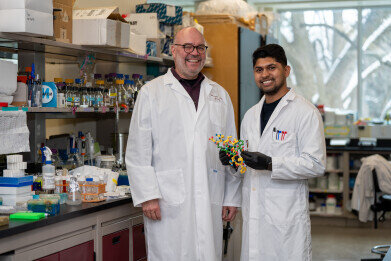 A new class of antibiotics has been identified by McMaster University researchers. [From left] Professor Gerry White with Dr. Manoj Jangra. Credit: McMaster University
Research news
Antibacterial compound found: McMaster team discovers wholly new class of antibiotics
Mar 26 2025
The last time a new class of antibiotics reached the market was almost three decades ago – but that could soon change, thanks to a discovery by researchers at McMaster University, Hamilton, Ontario.
A team led by Professor Gerry Wright, Department of Biochemistry and Biomedical Sciences at McMaster University, has identified a strong candidate which is effective against even the most drug-resistant bacteria on the planet: a new molecule called lariocidin. The findings were published in the journal Nature on March 26, 2025.
The discovery of the all-new class of antibiotics responds to a critical need for new antimicrobial medicines, as bacteria and other microorganisms evolve ways in which they can withstand the effects of existing drugs. Antimicrobial resistance has been identified as one of the top global public health threats by the World Health Organization.
“Our old drugs are becoming less and less effective as bacteria become more and more resistant to them,” said Wright.
“About 4.5 million people die every year due to antibiotic-resistant infections, and it’s only going to get worse.”
Wright and his team found that the new molecule – a lasso peptide – has a great deal of promise as an early drug lead because it attacks bacteria in a way that’s different from other antibiotics. Lariocidin binds directly to a bacterium’s protein synthesis machinery in a completely new way, inhibiting its ability to grow and survive.
“This is a new molecule with a new mode of action,” Wright said.
“It’s a big leap forward.”

Tuberculosis bacteria hiding in dead lung tissue can be treated by novel antibiotic
Around 10 million people contract tuberculosis (TB) annually – the disease caused by the Mycobacterium tuberculosis (Mtb) – with it then killing approximately 1.5 million patients each year.... Read More
Lariocidin is produced by a type of bacteria called Paenibacillus, which the researchers retrieved from a soil sample collected from a backyard in Hamilton, Ontario.
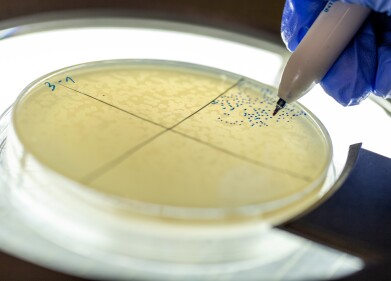
The research team allowed the soil bacteria to grow in the laboratory for approximately one year – a method that allowed for the slow-growing species of bacteria in the soil to be observed, that might otherwise have been missed. One of these bacteria, Paenibacillus, was producing a new substance that had strong activity against other bacteria, including those typically resistant to antibiotics.
“When we figured out how this new molecule kills other bacteria, it was a breakthrough moment,” says Dr. Manoj Jangra, a postdoctoral fellow in Wright’s lab.
In addition to its unique mode of action and its activity against otherwise drug-resistant bacteria, the researchers are optimistic about lariocidin because it ticks a lot of the right boxes for becoming a candidate drug:
- non-toxic to human cells
- not susceptible to existing mechanisms of antibiotic resistance
- works well in an animal model of infection.
Wright and his team are now focused on finding ways to modify the molecule and produce it in quantities large enough to allow for clinical development.
Wright said that because this new molecule is produced by bacteria – and “bacteria aren’t interested in making new drugs for us” – much time and resources will be needed before lariocidin is ready for market.
“The initial discovery – the big a-ha! Moment – was astounding for us, but now the real hard work begins,” Wright said.
“We’re working on ripping this molecule apart and putting it back together again to make it a better drug candidate.”
Digital Edition
Lab Asia Dec 2025
December 2025
Chromatography Articles- Cutting-edge sample preparation tools help laboratories to stay ahead of the curveMass Spectrometry & Spectroscopy Articles- Unlocking the complexity of metabolomics: Pushi...
View all digital editions







Events
Jan 21 2026 Tokyo, Japan
Jan 28 2026 Tokyo, Japan
Jan 29 2026 New Delhi, India
Feb 07 2026 Boston, MA, USA
Asia Pharma Expo/Asia Lab Expo
Feb 12 2026 Dhaka, Bangladesh




