-
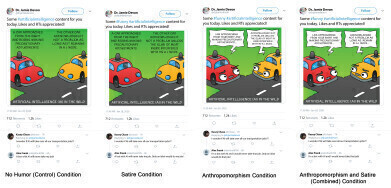 Examples of the tweets seen by participants. Credit: Alexandra L. Frank, Michael A. Cacciatore, Sara K. Yeo and Leona Yi-Fan Su
Research news
All joking aside, humour adds to trust in science's findings
May 05 2025
Appropriate jokes can improve effectiveness of science communication
In politics a good joke at the right time can be a valuable tool for to focus an audience’s attention and build trust. Science has been reluctant, however, to deploy humour even when engaging in science communication. The fear has been that a light-hearted approach could diminish authority in the message and therefore lower science’s perceived credibility.
Recent research challenges the commonly held assumption that humour undermines the credibility of scientific communication. A study led by Alexandra Lynn Frank, a doctoral candidate at the Grady College of Mass Communication, University of Georgia, demonstrates that humour – specifically when it successfully elicits mirth – can simultaneously enhance the likeability of a science communicator and strengthen perceptions of their message as a credible and appropriate source of scientific information.
This work contributes to a growing body of scholarship exploring humour’s role in science communication, particularly in non-traditional formats such as stand-up comedy and, more recently, social media. Frank and her colleagues sought to address a gap in existing literature by investigating audience responses to humorous content – in the form of satire and anthropomorphism – shared via social media platforms by scientists. The study focused on posts related to artificial intelligence and used cartoons shared by a fictional scientist, Dr. Jamie Devon, on Twitter/X. The humour strategies employed were classified into three categories: mild Horatian satire, anthropomorphism (depicting animals or objects with human traits), or a combination of both.
Using an online survey embedded with an experimental design, the researchers exposed 2,212 participants – recruited via quota sampling to reflect US Census demographics – to one of eight Twitter/X posts featuring an AI-themed cartoon. The posts varied in humour type across four conditions: no humour (control), anthropomorphism, satire, and a hybrid of the two. Participants then rated their emotional response in terms of mirth, assessed the likability of the communicator, and judged the perceived legitimacy of the post as a vehicle for scientific messaging.
The findings suggest that humour can be an effective tool in science communication—provided it genuinely resonates with audiences. Frank explains that – much like in politics, advertising, or entertainment – humorous content can foster interpersonal connection, reduce audience resistance, and improve message receptivity.
However, the effectiveness of humour is contingent on its perceived quality; failed humour, or humour perceived as inappropriate or forced, can diminish both trust and credibility. Moreover, the researchers caution that more aggressive forms of satire may be interpreted as hostile, potentially undermining the source’s authority and scientific ethos.
Ultimately, Frank emphasises the practical implications of these findings for science communicators: when thoughtfully executed, humour can humanize scientists, enhance public engagement, and contribute to science literacy by rendering complex topics more relatable and accessible. In doing so, it may also serve to counteract misinformation and stimulate curiosity about scientific issues, particularly in the fast-paced, informal environments of social media.




Digital Edition
Lab Asia Dec 2025
December 2025
Chromatography Articles- Cutting-edge sample preparation tools help laboratories to stay ahead of the curveMass Spectrometry & Spectroscopy Articles- Unlocking the complexity of metabolomics: Pushi...
View all digital editions










Events
Jan 21 2026 Tokyo, Japan
Jan 28 2026 Tokyo, Japan
Jan 29 2026 New Delhi, India
Feb 07 2026 Boston, MA, USA
Asia Pharma Expo/Asia Lab Expo
Feb 12 2026 Dhaka, Bangladesh




