-
-
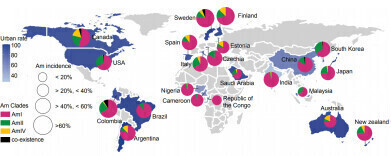 Diversity of A. muciniphila is influenced by urbanization and single clade predominance is widespread in human population. Credit: Korea Food Research Institute (KFRI)
Research news
Growth regulation mechanisms of core bacteria in human gut microbiome
Jul 16 2025
Mechanisms to suppress rival subtypes observed among subtypes of Akkermansia muciniphila
Researchers at the Korea Food Research Institute (KFRI) have identified key growth regulation mechanisms within the human gut microbiota, focusing on the bacterial species Akkermansia muciniphila – a leading candidate for microbiome-based therapies.
A. muciniphila is known to be abundant in the gut of healthy individuals, where it plays a vital role in maintaining physiological balance through the modulation of immune responses and insulin sensitivity.
The study, led by Dr Young-Do Nam at KFRI, was conducted in collaboration with Professor Kwang-Soon Kim at Pohang University of Science and Technology (POSTECH) and the biotech company EnteroBiome. Using large-scale gut microbiome datasets from individuals in South Korea, the team discovered that A. muciniphila comprises four distinct clades (I–IV), with typically only one clade present in any given individual.
The researchers hypothesised that the subtypes compete for dominance within the gut environment. Through comparative genomic and physiological analysis, in vitro co-culturing, and gnotobiotic experiments in germ-free mice, they confirmed this theory. Clade II (AmII), which exhibits limited mucin-degrading ability, was shown to secrete extracellular vesicles containing proteins that specifically target and lyse cells of clade I (AmI), a more efficient mucin utilising variant.
These vesicles disrupt AmI cell walls, effectively eliminating the competition. Moreover, the vesicles were found to stimulate AmII-specific immunoglobulin A (IgA) responses, further enhancing AmII colonisation within the host.
The findings indicate that certain A. muciniphila subtypes have evolved mechanisms to suppress rival subtypes using extracellular vesicles, thus compensating for metabolic disadvantages. This discovery represents a novel adaptive strategy among gut bacteria.
Dr Nam commented that the research, by clarifying competitive interactions among A. muciniphila clades based on Korean microbiome data, could support the design of precision nutritional interventions aimed at selectively modulating gut microbial composition.
For further reading please visit: 10.1038/s41467-025-57631-x




Digital Edition
Lab Asia Dec 2025
December 2025
Chromatography Articles- Cutting-edge sample preparation tools help laboratories to stay ahead of the curveMass Spectrometry & Spectroscopy Articles- Unlocking the complexity of metabolomics: Pushi...
View all digital editions










Events
Jan 21 2026 Tokyo, Japan
Jan 28 2026 Tokyo, Japan
Jan 29 2026 New Delhi, India
Feb 07 2026 Boston, MA, USA
Asia Pharma Expo/Asia Lab Expo
Feb 12 2026 Dhaka, Bangladesh




