-
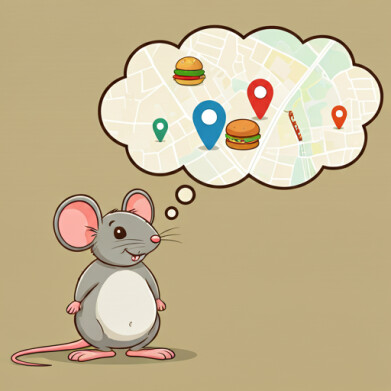 A specific population of neurons in the mouse brain encodes spatial memories for sugar and fat in the real world, impacting food intake and weight. Credit: Guilliaume de Lartigue, PhD, Monell Chemical Senses Center
Research news
Memory systems in the mouse brain found to drive food cravings that could influence weight gain
Jan 15 2025
Neurons in the hippocampus have been shown to encode memories of sugar and fat, shaping feeding behaviour and metabolic health in mouse models
Do memories influence what and how much we eat? A study a team at Monell Chemical Senses Center, University of Pennsylvania, has linked food memory to overeating, and resoundingly answered that question as: “Yes!”
Led by Dr Guillaume de Lartigue, the researchers have identified the brain’s food-specific memory system and its direct role in overeating and diet-induced obesity.
Published in Nature Metabolism, they describe a specific population of neurons in the mouse brain that encode memories for sugar and fat, profoundly impacting food intake and body weight.
“We are bombarded [these days] with so many environmental triggers designed to remind us of pleasurable food experiences,” said Dr. de Lartigue.
“What’s [been] surprising is that we’ve now pinpointed a specific population of neurons in the hippocampus that forms these food-related memories and [importantly] drives our [future] eating behaviour.
“These connections could have significant implications for body weight and metabolic health,” he added.
The neurons encode memories of the spatial location in the real world of nutrient-rich foods ─ acting as a ‘memory trace’ ─ but particularly for sugar and fat. Silencing these neurons impaired an animal’s ability to recall sugar-related memories and so reduces its sugar consumption. This prevents weight gain even when the animals are exposed to diets that [usually] contribute to excessive weight gain and obesity.
Conversely, reactivating these neurons enhances memory for food, increasing consumption and demonstrating how food memories influence dietary behaviour.
These findings introduce two new concepts:
- Evidence that specific neurons in the brain store food-related memories.
- Memories directly impact food intake.
“While it’s no surprise that we remember pleasurable food experiences, it was long assumed that these memories had little to no impact on eating behaviour,” said Dr. de Lartigue.
“What’s most surprising is that inhibition of these neurons prevents weight gain, even in response to diets rich in fat and sugar,” he added.
What sets this discovery apart from other studies related to memory is its implications for understanding metabolic health. Deleting sugar-responsive neurons in the hippocampus of the animals not only disrupts memory but also reduces sugar intake and protects against weight gain or obesity, even when animals are exposed to high-sugar diets.
This highlights a direct link between certain brain circuits involved in memory and metabolic health, which has been largely overlooked in the field of obesity research.
“Memory systems in the hippocampus evolved to help animals locate and remember food sources critical for survival,” said Mingxin Yang, first author of the study and doctoral candidate at the University of Pennsylvania.
“In modern environments, where food is abundant and cues are everywhere, these memory circuits may drive overeating, contributing to obesity,” she said.
Another key discovery was that food-related memories are highly specific. Sugar-responsive neurons encode and influence only sugar-related memories and intake. Likewise for fat-responsive neurons only impacting on intake of fats. Neither do these neurons affect other types of memory, such as spatial memory for non-food-related tasks.
“The specificity of these circuits is fascinating,” said de Lartigue. “It underscores how finely tuned the brain is for linking food to behaviour, ensuring animals can differentiate between various nutrient sources in their environment.
Separate systems have presumably evolved because foods in nature rarely contain both fat and sugar, the authors have surmised.
The study’s findings open new possibilities for addressing overeating and obesity. By targeting hippocampal memory circuits, it may be possible to disrupt the memory triggers that drive consumption of unhealthy, calorie-dense foods.
For further reading please visit: 10.1038/s42255-024-01194-6
— Additional reporting by Alan Booth


Digital Edition
Lab Asia Dec 2025
December 2025
Chromatography Articles- Cutting-edge sample preparation tools help laboratories to stay ahead of the curveMass Spectrometry & Spectroscopy Articles- Unlocking the complexity of metabolomics: Pushi...
View all digital editions










Events
Jan 21 2026 Tokyo, Japan
Jan 28 2026 Tokyo, Japan
Jan 29 2026 New Delhi, India
Feb 07 2026 Boston, MA, USA
Asia Pharma Expo/Asia Lab Expo
Feb 12 2026 Dhaka, Bangladesh




