-
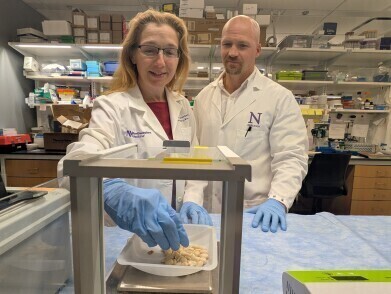 Study authors Drs. Stephanie Eisenbarth and Adam Williams weighing peanuts used in food allergy testing in their lab at Northwestern University Feinberg School of Medicine. Credit: Northwestern University
 -
 Credit: Northwestern University
 -
 Credit: Northwestern University
Research news
Asthma drug Zileuton blocks pathway of anaphylaxis in mice with peanut allergy
Aug 07 2025
Study finds new biological trigger for anaphylaxis and a drug that worked ‘shockingly well’ to stop it
An approved drug for treatment of asthma has been found for severe, acute allergic responses to food allergens in mouse models, according to a study by a team from Northwestern University Feinberg School of Medicine, Michegan. The findings reveal a previously unrecognised molecular pathway that could help to protect individuals at risk of severe food allergy and anaphylaxis.
Anaphylaxis is a rapid and potentially fatal immune response that can follow allergen exposure in sensitised individuals. The research team discovered that the drug Zileuton – which has been approved by the Food and Drug Administration (FDA) in the United States – to inhibit leukotriene production in asthma patients, could also prevent anaphylaxis in mice with peanut allergy.
“After treatment with Zileuton, 95% of the mice showed almost no symptoms of anaphylaxis.
“The treatment reversed their risk from 95% susceptible to 95% protected,” said Dr Adam Williams, co-senior author of the study and Associate Professor of Medicine (Allergy and Immunology) at Feinberg.
“This is a totally different, out-of-the-box approach to treat food allergy, unlike anything we’ve tried before,” he added.
The scientists identified a key role for a gene called dipeptidase 1 (DPEP1), which they found to be essential in regulating the anaphylactic response. Through a forward genetic screen in mice, the team established that mutations in DPEP1 altered susceptibility to food allergy, owing to its control of leukotriene synthesis in the gut. Zileuton, by blocking this pathway, prevented symptoms in nearly all mice exposed to peanut extract.
“It was actually shocking how well Zileuton worked,” said Dr Stephanie Eisenbarth, Director of the Center for Human Immunobiology and Chief of the Division of Allergy and Immunology at Feinberg.
Food allergies affect more than 33 million people in the US alone – nearly one in ten people – yet clinicians remain unable to predict reliably who is at risk of a severe reaction. Current therapeutic options are limited to two FDA–approved interventions: an oral immunotherapy for peanut allergy, which does not work for all patients and can itself trigger reactions, and omalizumab, an injectable monoclonal antibody therapy that is expensive and not universally effective.
By contrast, Zileuton is a small-molecule drug already authorised for another indication and taken orally. If its effect in humans mirrors that seen in mice, it could represent a simple prophylactic treatment to provide short-term protection for allergic individuals prior to potential exposure.
“For parents sending their child to a birthday party, or for anyone flying where they can’t control what’s being served, this could be a powerfully protective drug,” said Williams.
The Northwestern team has already launched a Phase I clinical trial to assess whether the protective effects of Zileuton in mice translates into humans. The study has also offered insight into longstanding questions about immune tolerance: why some individuals with laboratory-confirmed allergy do not react to food exposure, and how some people develop clinical allergy while others do not.
“Our findings open a whole new area for future research into how people develop food allergies in the first place, and why some react while others don’t.
“Let’s say you’re told you’re allergic to peanuts based on a blood test, but you’ve eaten peanuts your whole life without any problems. This pathway we discovered may be one explanation for why some of those people are protected.”
“If you’d asked me five or six years ago to guess the pathway that would lead to this discovery, I never would have picked this gene or the leukotriene molecules,” Eisenbarth said.
She added that the work underscores the importance of sustained investment in long-term, curiosity-driven research.
For further reading please visit: 10.1126/science.adp0240



Digital Edition
Lab Asia Dec 2025
December 2025
Chromatography Articles- Cutting-edge sample preparation tools help laboratories to stay ahead of the curveMass Spectrometry & Spectroscopy Articles- Unlocking the complexity of metabolomics: Pushi...
View all digital editions








Events
Jan 21 2026 Tokyo, Japan
Jan 28 2026 Tokyo, Japan
Jan 29 2026 New Delhi, India
Feb 07 2026 Boston, MA, USA
Asia Pharma Expo/Asia Lab Expo
Feb 12 2026 Dhaka, Bangladesh




