-
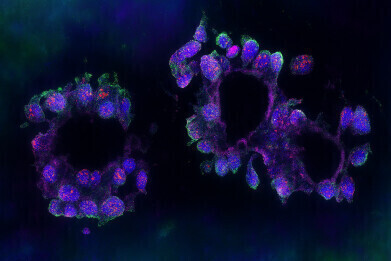 This triple-negative breast cancer organoid was grown in the lab using tissue samples donated by a volunteer patient. LINC01235 is seen in red. Credit: Spector lab/CSHL
Research news
Link to triple-negative breast cancer identified in RNA study
Jul 10 2025
Triple-negative breast cancer (TNBC), an aggressive and hard-to-treat form of breast cancer, has long challenged researchers due to the absence of effective targeted therapies. Now, findings from Cold Spring Harbor Laboratory in New York State have revealed a potentially significant contributor to TNBC biology: a little-studied long non-coding RNA (lncRNA) known as LINC01235.
Breast cancer is among the most common malignancies in women worldwide, and TNBC accounts for approximately 10 to 15 percent of cases. It is disproportionately diagnosed in younger women and those of African American descent. While many forms of breast cancer benefit from targeted treatments, TNBC lacks such options, making basic research crucial.
The study was led by Professor David Spector and graduate student Wenbo Xu. They discovered that LINC01235, previously associated with gastric cancer, also plays a role in TNBC by regulating a gene called NFIB, which is already linked to this cancer subtype.
Using CRISPR gene-editing and antisense knockdown techniques in tumour organoids and cancer cells, the researchers showed that lowering LINC01235 levels suppressed NFIB expression and inhibited TNBC organoid growth. Further analysis suggested that this interaction affects the NOTCH signalling pathway, known to be involved in cancer cell proliferation.
The NOTCH signalling pathway is a fundamental cell communication system that regulates how cells develop, differentiate, and interact with their environment. It is evolutionarily conserved and plays a crucial role in embryonic development, tissue homeostasis, and cell fate decisions. In TNBC aberrant NOTCH signalling can lead to uncontrolled cell proliferation, resistance to apoptosis and enhanced tumour invasiveness.
Very little is known about NFIB’s function in this context and even less about LINC01235.
“The goal here is to understand mechanisms by which the cell functions and how disease states take over those functions, perhaps by up-regulating or down-regulating an RNA molecule,” Spector noted.
While these results are at a preliminary stage, the work points to the promise of lncRNAs as potential therapeutic targets. LINC01235 may yet prove to be a vital step towards effective treatment options for TNBC.
For further reading please visit: 10.1158/1541-7786.MCR-24-1143



Digital Edition
Lab Asia Dec 2025
December 2025
Chromatography Articles- Cutting-edge sample preparation tools help laboratories to stay ahead of the curveMass Spectrometry & Spectroscopy Articles- Unlocking the complexity of metabolomics: Pushi...
View all digital editions








Events
Jan 21 2026 Tokyo, Japan
Jan 28 2026 Tokyo, Japan
Jan 29 2026 New Delhi, India
Feb 07 2026 Boston, MA, USA
Asia Pharma Expo/Asia Lab Expo
Feb 12 2026 Dhaka, Bangladesh




