-
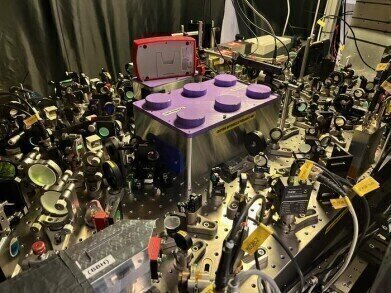 A tabletop experiment typical of the setup. The size is more or less equal to the size of an ordinary dining table. Credit: Ola Jakup Joensen
Research news
Quantum system breaks sensitivity barrier in tabletop optical sensing
Jul 23 2025
Researchers at the Niels Bohr Institute, University of Copenhagen, have developed a tunable quantum system that has significantly improved the sensitivity of multiple sensing technologies, including biomedical diagnostics and gravitational wave detection.
The team has demonstrated a method for surpassing the so-called standard quantum limit – a threshold imposed by quantum noise on conventional measurement techniques. By combining two entangled beams of light with an atomic spin ensemble, the researchers achieved broadband suppression of both back-action and detection noise, which represent two fundamental sources of quantum uncertainty.
Optical sensing is already widely used, from magnetic resonance imaging (MRI) to environmental monitoring. However, improving its sensitivity requires sophisticated techniques such as squeezed light, back-action evasion and quantum entanglement. The Copenhagen system employed frequency-dependent squeezing, reducing the quantum noise of light across a broad frequency range.
This effect was achieved by directing squeezed light through an atomic spin ensemble capable of frequency-dependent phase rotation. Moreover, the ensemble inverted the sign of the quantum noise, enabling enhanced suppression when the output was combined with that of the sensor.
“The sensor and the spin system interact with two entangled beams of light. After the interaction, the two beams are detected and the detected signals are combined. The result is broadband signal detection beyond the standard quantum limit of sensitivity,” explained Professor Eugene Polzik, who led the study.
Conventional quantum sensing technologies – such as those used in gravitational wave observatories including LIGO, in the United States and Virgo, in Italy – depend on optical resonators extending over several kilometres. By contrast, the Copenhagen system achieved comparable noise suppression using a tabletop-sized device, marking a substantial advance in miniaturisation and adaptability.
The architecture, based on macroscopic entanglement between multiphoton light states and atomic ensembles, holds promise for applications in magnetic field detection, precision timekeeping and accelerometry. In biomedical contexts, it could enhance the resolution of MRI and increase the sensitivity of biosensors used for early disease detection.
The researchers also modelled the potential application of their system in next-generation gravitational wave observatories, such as the Einstein Telescope proposed in Europe, to improve the detection of spacetime ripples caused by black hole or neutron star collisions.
Beyond sensing, the system could support emerging capabilities in quantum communication and computing. It may be adapted for use in quantum repeaters – devices that extend the range of quantum signals – or as quantum memory components for future distributed quantum networks.
Tunable quantum systems, such as the one developed at the University of Copenhagen, have the potential to transform a broad range of biomedical and laboratory applications by dramatically enhancing sensitivity and measurement precision.
In MRI quantum noise suppression could substantially improve the signal-to-noise ratio. This would allow for higher spatial resolution, faster scan times and a reduced need for contrast agents, making it especially useful in detecting early-stage tumours, neurological disorders and metabolic abnormalities.
Similarly, in biomagnetic sensing applications such as magnetoencephalography and magnetocardiography, which rely on the detection of weak magnetic fields produced by the brain and heart, quantum sensors could deliver greater spatial and temporal resolution. This could, ultimately, open up possibilities for portable or wearable diagnostic tools capable of real-time monitoring.
And in the field of biosensing, quantum-enhanced systems could enable label-free detection of disease biomarkers, such as proteins, DNA or exosomes, even at very low concentrations. Such improvements may allow for earlier diagnosis of cancer and neurodegenerative diseases, particularly in complex biological samples such as serum or saliva.
These systems also show promise for tracking single molecules or nanoparticles. By aiding optical trapping and high-precision imaging techniques, quantum noise suppression could facilitate real-time observation of molecular interactions, including drug–target binding or enzymatic activity.
Laboratory techniques that rely on spectroscopy and microscopy could also benefit. Tunable quantum systems are expected to extend the capabilities of Raman and infrared spectroscopy, as well as super-resolution microscopy, making it possible to detect chemical signatures at extremely low concentrations, distinguish fine variations in tissue composition, and identify pathogens in complex matrices.
In clinical laboratory instrumentation, devices such as mass spectrometers, flow cytometers and lab-on-a-chip systems could also incorporate quantum components to boost reproducibility and improve confidence in the detection of low-abundance analytes.
In vivo, miniaturised quantum sensors could be implanted or worn to monitor physiological parameters in real time. These could include glucose levels, pH changes, ion gradients, or biochemical markers such as reactive oxygen species or nitric oxide, providing a platform for personalised and continuous health monitoring.
Finally, tunable quantum systems may also advance pharmacokinetic studies by tracking the distribution, binding and metabolism of drugs with high temporal precision. This would support more accurate dosing, early detection of off-target effects, and greater insight into therapeutic efficacy.
For further reading please visit: 10.1038/s41586-025-09224-3


Digital Edition
Lab Asia Dec 2025
December 2025
Chromatography Articles- Cutting-edge sample preparation tools help laboratories to stay ahead of the curveMass Spectrometry & Spectroscopy Articles- Unlocking the complexity of metabolomics: Pushi...
View all digital editions









Events
Jan 21 2026 Tokyo, Japan
Jan 28 2026 Tokyo, Japan
Jan 29 2026 New Delhi, India
Feb 07 2026 Boston, MA, USA
Asia Pharma Expo/Asia Lab Expo
Feb 12 2026 Dhaka, Bangladesh




