-
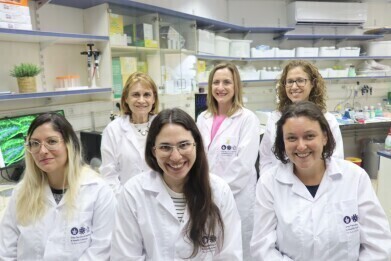 [Front row, from left] Shir Quinn, Mor Yam, Danielle Galber; [Back row, from left] Professor Aviva Fattal-Valevski, Professor Karen Avraham, Professor Moran Rubinstein. Credit: Tel Aviv University
Research news
Exceptionally rare neurological disorder may have precision medicine treatment
Jul 11 2025
Israeli–US research collaboration marks a step forward in drug development for GRIN2D mutation
Researchers at the Gray Faculty of Medical and Health Sciences, Tel Aviv University, Israel, have developed a mouse model that accurately replicated an extremely rare and often fatal genetic disorder caused by mutations in the GRIN2D gene. The model enabled the study of disease characteristics and the testing of existing and novel therapeutic agents, offering hope to the affected children and their families.
The study was led by Professor Moran Rubinstein and Professor Karen Avraham, Dean of the Faculty. Collaborators included students from the Gray Faculty and the Sagol School of Neuroscience, clinicians from the Dana–Dwek Children’s Hospital at Tel Aviv Sourasky Medical Center, and Professors Christopher Makinson and Wayne Frankel from Columbia University, United States.
Professor Avraham explained that the project was initiated following an approach from the parents of Adam, an Israeli child now aged eight, who is one of around 40 individuals worldwide diagnosed with the GRIN2D-related disorder. The mutation results in developmental epilepsy, profound motor and cognitive delays, and in some cases, early death.
The first mouse model developed was so severely affected that the animals died within weeks, preventing experimental work. However, using genetic engineering, the team produced a viable test subject animal in which half of its offspring carried the mutation and developed symptoms similar to human patients. Most of the affected mice survived only a few weeks, although a small number lived up to three months.
Using this model, the researchers identified the onset and progression of symptoms across developmental stages. Epilepsy, hyperactivity and motor impairments emerged in early life, while cognitive deficits worsened over time. Brain activity, assessed via electroencephalography, revealed a continuous disruption, unlike typical forms of epilepsy. The same abnormalities were identified in both mice and humans, supporting the model’s validity.
Neuronal activity and structure in the cerebellum also differed markedly from healthy controls, with early hypoactivity followed by impaired inter-neuronal communication and structural abnormalities.
The team then used the model to test drug responses. Ketamine, which had previously been proposed as a treatment was found to exacerbate seizures. However, memantine and phenytoin offered partial improvements in brain function and seizure control.
Professor Moran Hausman-Kedem highlighted the model’s clinical significance, noting its value in evaluating drug safety and efficacy where patient numbers preclude large trials. Professor Rubinstein added that ongoing work includes testing new pharmacological and genetic therapies, with encouraging early signs of improved cognition, motor function and survival.
The research received support from the US–Israel Binational Science Foundation, the GRIN2D Project Foundation, and CureGRIN, a patient-led initiative promoting collaboration between families, clinicians and researchers.
For further reading please visit: 10.1093/brain/awaf149/8119851



Digital Edition
Lab Asia Dec 2025
December 2025
Chromatography Articles- Cutting-edge sample preparation tools help laboratories to stay ahead of the curveMass Spectrometry & Spectroscopy Articles- Unlocking the complexity of metabolomics: Pushi...
View all digital editions





Events
Jan 21 2026 Tokyo, Japan
Jan 28 2026 Tokyo, Japan
Jan 29 2026 New Delhi, India
Feb 07 2026 Boston, MA, USA
Asia Pharma Expo/Asia Lab Expo
Feb 12 2026 Dhaka, Bangladesh