Research news
COVID-19 infection linked to higher risk of asthma while vaccine cuts risk of respiratory disease
Sep 05 2025
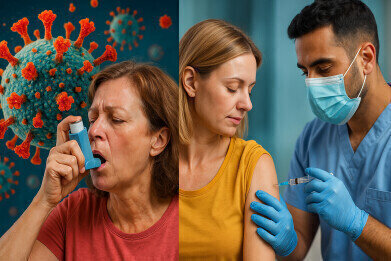
People who had COVID-19 were at increased risk of inflammatory airway diseases such as asthma, hay fever and chronic sinusitis, according to an international study led by researchers at Karolinska Institutet in Stockholm, Sweden. Vaccination against the SARS-CoV-2 virus appeared to reduce the risk.
The research team drew on the United States-based electronic health record database TriNetX to examine associations between COVID-19 and type-2 inflammatory diseases – a group of chronic conditions caused by overreaction of the immune system to allergens or infections – such as asthma, eczema, hay fever and food allergies among other conditions.
The study compared 973,794 people with a history of COVID-19 against 691,270 individuals who had been vaccinated against SARS-CoV-2 and 4,388,409 healthy controls with no documented infection or vaccination. The findings showed that people with previous COVID-19 infection had a 66 per cent higher risk of asthma, a 74 per cent higher risk of chronic sinusitis and a 27 per cent higher risk of hay fever compared with controls. By contrast, no increased risk was observed for atopic eczema or eosinophilic oesophagitis, an inflammatory disease of the oesophagus.
“Our results suggest that COVID-19 can trigger type-2 inflammation in the airways, but not in other organs,” said Dr. Philip Curman, of the Department of Medical Epidemiology and Biostatistics at Karolinska Institutet, and the study’s leader.
Vaccination appeared to have the opposite effect. The risk of asthma was 32 per cent lower among vaccinated individuals compared with unvaccinated controls, with slightly lower risks also recorded for sinusitis and hay fever.
When those who had been infected were compared with vaccinated individuals, the difference was greater still. People who had contracted COVID-19 had more than twice the risk of asthma or chronic sinusitis and a 40 per cent higher risk of hay fever than those who had been vaccinated.
“It is interesting to see that vaccination not only protects against the infection itself but also appears to provide good protection against certain respiratory complications,” said Curman.
The study was retrospective and relied on existing medical records, which meant the researchers could not draw firm conclusions about causality. The authors also noted that undiagnosed infections may have gone unrecorded, particularly those detected through self-testing.
The research was conducted in collaboration with the University of Lübeck and the Lübeck Institute of Experimental Dermatology in Germany, the Technical University of Madrid in Spain and Bar-Ilan University in Israel. Two researchers received travel grants from TriNetX, the provider of the database, and one of the authors is employed by the company.
For further reading please visit: 10.1016/j.jaci.2025.07.030




Digital Edition
Lab Asia Dec 2025
December 2025
Chromatography Articles- Cutting-edge sample preparation tools help laboratories to stay ahead of the curveMass Spectrometry & Spectroscopy Articles- Unlocking the complexity of metabolomics: Pushi...
View all digital editions










Events
Jan 21 2026 Tokyo, Japan
Jan 28 2026 Tokyo, Japan
Jan 29 2026 New Delhi, India
Feb 07 2026 Boston, MA, USA
Asia Pharma Expo/Asia Lab Expo
Feb 12 2026 Dhaka, Bangladesh




