-
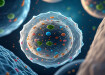
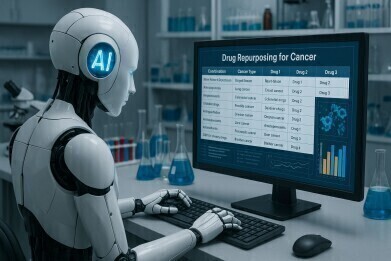 An AI-generated image of a LLM-machine learning model being used to search for non-cancer drug combinations to test in oncology settings. Credit: A.Booth via ChatGPT
Research news
‘AI scientist’ used to identify non-cancer drug combinations that show promise in treating cancer cells
Jun 17 2025
A large language model (LLM), working alongside human researchers, has identified combinations of inexpensive and widely used non-cancer drugs that show potential in killing cancer cells. The collaborative project, led by the University of Cambridge, represents a novel approach to drug discovery using artificial intelligence (AI).
Using the GPT-4 model – developed by OpenAI – the researchers searched to uncover new uses for existing medications with regulatory marketing authorisation, among them those used to treat high cholesterol and alcohol dependence. The LLM was tasked with scanning vast volumes of scientific literature to look for patterns and propose combinations of drugs that could effectively target cancer cells while leaving healthy cells unharmed. Importantly, it was instructed to avoid established cancer treatments and to focus on medicines already approved for uses other than oncology but already deemed safe and affordable.
To test the LLM’s potential, the team asked GPT-4 to suggest drugs that could combat a specific breast cancer cell line frequently used in research. Twelve combinations were initially tested in the laboratory. Three outperformed standard breast cancer drugs. Using these experimental outcomes as feedback, GPT-4 proposed four additional combinations, three of which also proved effective.
The findings mark the first reported use of a ‘closed-loop system’ in which LLM-generated hypotheses are tested in the laboratory and then refined through experimental results. The researchers describe this as a new form of scientific collaboration, in which supervised LLMs act not as replacements for scientists but as innovative research partners.
“Supervised LLMs offer a scalable, imaginative layer of scientific exploration, and can help us as human scientists explore new paths that we had not thought of before,” said Professor Ross King from the Department of Chemical Engineering and Biotechnology at the University of Cambridge, who led the study.
“This can be useful in areas such as drug discovery, where there are many thousands of compounds to search through,” he added.
One notable aspect of using LLMs in this context is their tendency to produce so-called hallucinations, outputs that are factually incorrect. However, in scientific research, such creative missteps can occasionally lead to valuable hypotheses that would not otherwise be considered.
“This is not automation replacing scientists, but a new kind of collaboration,” said co-author Dr Hector Zenil of King’s College London.
“Guided by expert prompts and experimental feedback, the AI functioned like a tireless research partner – rapidly navigating an immense hypothesis space and proposing ideas that would take humans alone far longer to reach,” he said.
The researchers emphasised that the most promising combinations emerged from iterative feedback loops between the AI and the laboratory team. For example, the pairing of simvastatin, a cholesterol-lowering statin, with disulfiram, used to treat alcohol dependence, demonstrated significant activity against breast cancer cells. Such combinations highlight the potential of repurposing existing medicines for oncological applications.
“This study demonstrates how AI can be woven directly into the iterative loop of scientific discovery, enabling adaptive, data-informed hypothesis generation and validation in real time,” said Dr Zenil.
Before any of these drug combinations could be considered for clinical use in cancer treatment, extensive testing in clinical trials would be required.
“The capacity of supervised LLMs to propose hypotheses across disciplines, incorporate prior results and collaborate across iterations marks a new frontier in scientific research. An AI scientist is no longer a metaphor without experimental validation – it can now be a collaborator in the scientific process,” added Professor King.
The research received support from the Knut and Alice Wallenberg Foundation and the UK Engineering and Physical Sciences Research Council (EPSRC).
For further reading please visit: 10.1098/rsif.2024.0674

Digital Edition
Lab Asia Dec 2025
December 2025
Chromatography Articles- Cutting-edge sample preparation tools help laboratories to stay ahead of the curveMass Spectrometry & Spectroscopy Articles- Unlocking the complexity of metabolomics: Pushi...
View all digital editions








Events
Jan 21 2026 Tokyo, Japan
Jan 28 2026 Tokyo, Japan
Jan 29 2026 New Delhi, India
Feb 07 2026 Boston, MA, USA
Asia Pharma Expo/Asia Lab Expo
Feb 12 2026 Dhaka, Bangladesh




