Research news
AI tool designs drugs which can target proteins previously thought to be ‘undruggable’
Aug 25 2025
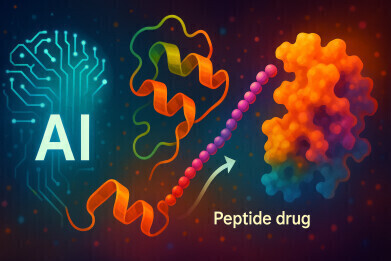
A multi-institutional team has re-engineered an artificial intelligence (AI) language model to design peptide drugs that can bind to and degrade disease-related proteins which lack stable three-dimensional structures. The work has opened up possible avenues to treat conditions that have resisted traditional drug development, including certain cancers, neurodegenerative disorders and also viral infections.
The system, called PepMLM, originated from an algorithm designed to interpret human language in chatbots but was trained instead to recognise the ‘language’ of proteins. Unlike earlier AI drug design tools, such as AlphaFold – which won the 2024 Nobel Prize in Chemistry for predicting protein structures – PepMLM uses only the protein’s amino acid sequence to design candidate peptide drugs. This approach has enabled the targeting of a broader range of proteins previously regarded as ‘undruggable’.
“Most drug design tools rely on knowing the 3D structure of a protein, but many of the most important disease targets do not have stable structures,” said Dr. Pranam Chatterjee, senior author of the study, who led the work at Duke University and is now a faculty member at the University of Pennsylvania.
“PepMLM changes the game by designing peptide binders using only the protein’s amino acid sequence,” he added.
In laboratory experiments, PepMLM designed peptides – short chains of amino acids – that bound to and, in some cases, promoted the destruction of proteins implicated in cancer, reproductive disorders, Huntington’s disease, and viral infections.
“This is one of the first tools that can design these kinds of molecules directly from the protein’s sequence. It opens the door to faster, more effective ways to develop treatments,” said Chatterjee.
Christina Peng, a doctoral candidate in the Truant Lab at McMaster University, Hamilton, Ontario, Canada, led the Huntington’s disease studies.
“It is exciting to see how these AI-designed peptides can actually work inside cells to break down toxic proteins,” she said.
The Cornell University teams of Dr. Matthew DeLisa and Dr. Hector Aguilar tested the peptides on viral proteins, while Chatterjee’s team at Duke developed and validated the AI model.
Dr. Ray Truant, professor of biochemistry and biomedical sciences at McMaster, said: “We can now bind any protein to any other protein. We can degrade harmful proteins, stabilise beneficial ones, or control how proteins are modified – depending on the therapeutic goal.”
The researchers are already developing next-generation algorithms, including PepTune and MOG-DFM, to improve peptide stability, targeting and delivery within the body.
“Our ultimate goal is a general-purpose, programmable peptide therapeutic platform – one that starts with a sequence and ends with a real-world drug,” said Chatterjee.
For further reading please visit: 10.1038/s41587-025-02761-2

Digital Edition
Lab Asia Dec 2025
December 2025
Chromatography Articles- Cutting-edge sample preparation tools help laboratories to stay ahead of the curveMass Spectrometry & Spectroscopy Articles- Unlocking the complexity of metabolomics: Pushi...
View all digital editions








Events
Jan 21 2026 Tokyo, Japan
Jan 28 2026 Tokyo, Japan
Jan 29 2026 New Delhi, India
Feb 07 2026 Boston, MA, USA
Asia Pharma Expo/Asia Lab Expo
Feb 12 2026 Dhaka, Bangladesh




