Laboratory products
Faster Characterisation of Enzymes with Micro-Volume Analysis Instrument
Apr 11 2013
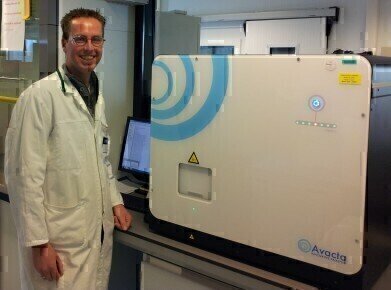
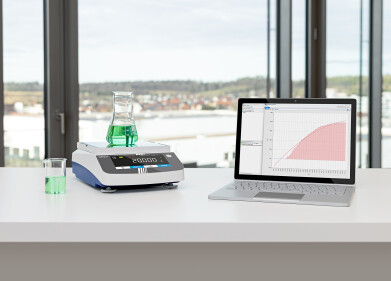
The DSM Biotechnology Centre, based in Delft, Netherlands, is taking advantage of Avacta Analytical’s Optim® 1000 micro-volume protein analysis instrument to characterise enzymes for use in the food industry. Mark Stor, an associate scientist in the applied biochemistry department, explained: “Enzymes are sold on an activity basis, and that requires biochemical characterisation to establish what the enzyme looks like and how it behaves. We need to know the limitations of each enzyme to determine which applications it is most suitable for.”
“We saw the Optim at some laboratory fairs, and were interested in its ability to run temperature gradients and produce stability profiles. This is really important for us; stability is always an issue with enzymes. If an enzyme is produced at 30°C, will it also work at 60°C? We have to test the enzyme to establish its limits, looking at its activity at different temperatures and in a range of formulations. To do this manually is extremely time consuming, but using the Optim it is possible to study 96 formulations in a day, obtaining a complete temperature profile that gives an indication of the most stable products. It is much quicker, and reduces the amount of work required. We can screen samples more quickly and, in the future, may even be able to replace lengthy shelf life studies.”
Digital Edition
Lab Asia Dec 2025
December 2025
Chromatography Articles- Cutting-edge sample preparation tools help laboratories to stay ahead of the curveMass Spectrometry & Spectroscopy Articles- Unlocking the complexity of metabolomics: Pushi...
View all digital editions









Events
Jan 21 2026 Tokyo, Japan
Jan 28 2026 Tokyo, Japan
Jan 29 2026 New Delhi, India
Feb 07 2026 Boston, MA, USA
Asia Pharma Expo/Asia Lab Expo
Feb 12 2026 Dhaka, Bangladesh




