-
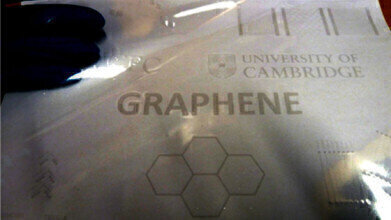 The image shows a printed graphene device. Credit: Andrea Ferrari.
News
Graphene: Taking the Wonder-Stuff from Dream to Reality
Feb 11 2013
A centre for research on graphene, a material which has the potential to revolutionise numerous industries, ranging from healthcare to electronics, has just opened at the University of Cambridge, with a dedicated facility due to open at the end of the year.
With the University already acting as a hub for graphene engineering, the objective of the new Cambridge Graphene Centre is to make this “wonder material” work in real-life applications bridging the gap between academia and industry. It will also be a shared research facility with state-of-the-art equipment, which any scientist researching graphene will have the opportunity to use.
Activities at the Centre will be funded by a Government grant worth more than £12 million, which was allocated to the University in December by the Engineering and Physical Sciences Research Council (EPSRC). The rest of this money will support projects focusing both on how to manufacture high-quality graphene on an industrial scale, and on developing some of its potential applications.
Graphene, a one-atom thick layer of graphite, is exceptionally
strong, yet also lightweight and flexible; it enables electrons to flow faster than silicon and functions as a transparent conductor. The first job for those working in the Cambridge Graphene Centre will be to find ways of manufacturing and optimising graphene films, dispersions and inks so that it can be used to good effect.
Professor Andrea Ferrari, who will be the Centre’s Director, said: “We are now in the second phase of graphene research, following the award of the Nobel Prize to Geim and Novoselov. That means we are targeting applications and manufacturing processes, and broadening research to other two-dimensional materials and hybrid systems. The integration of these new materials could bring a new dimension to future technologies, creating faster, thinner, stronger, more flexible broadband devices.”
The Government funding for the Centre is complemented by strong industrial support, worth an additional £13 million, from over 20 partners, including Nokia, Dyson, Plastic Logic, Philips and BaE systems. A further £11M of European Research Council funding will support activities with the Graphene Institute in Manchester, and Lancaster University.
Further information on www.cam.ac.uk/research

Digital Edition
Lab Asia Dec 2025
December 2025
Chromatography Articles- Cutting-edge sample preparation tools help laboratories to stay ahead of the curveMass Spectrometry & Spectroscopy Articles- Unlocking the complexity of metabolomics: Pushi...
View all digital editions









Events
Jan 21 2026 Tokyo, Japan
Jan 28 2026 Tokyo, Japan
Jan 29 2026 New Delhi, India
Feb 07 2026 Boston, MA, USA
Asia Pharma Expo/Asia Lab Expo
Feb 12 2026 Dhaka, Bangladesh




